One-dimensional array of acetylene molecules adsorbed in a metal-organic microporous material

利用事例本文
Powder diffraction is a powerful technique to study crystal structures. Using this technique, one can measure structural parameters such as lattice parameters, atomic positions, etc of crystalline materials. By using synchrotron radiation one can also obtain charge density level structures closely related with physical properties as well as structural parameters. The figure shows charge density distributions obtained by analyzing diffraction data of a metal-organic solid under acetylene gas adsorption. These data reveal the fact that adsorbed acetylene molecules(green color)form a one-dimensional array in a metal-organic microporous material.
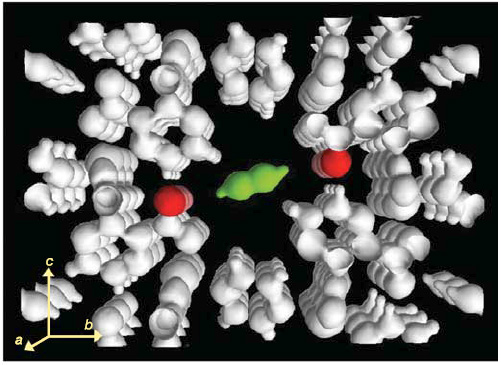
Fig. Charge densities of a metal-organic microporous material with acetylene molecules.
[ R. Matsuda, R. Kitaura, S. Kitagawa, Y. Kubota, R. V. Belosludov, T. C. Kobayashi, H. Sakamoto, T. Chiba, M. Takata, Y. Kawazoe and Y. Mita, Nature 436, 238-241 (2005), Fig. 4,
©2005 Nature Publishing Group ]
学術利用キーワード
| A. 試料 | 有機材料 |
|---|---|
| B. 試料詳細 | 結晶性固体, 低分子有機材料, 結晶 |
| C. 手法 | X線回折 |
| D. 手法の詳細 | 粉末結晶構造解析 |
| E. 付加的測定条件 | 低温(〜液体窒素), ガス吸着 |
| F. エネルギー領域 | X線(4~40 keV) |
| G. 目的・欲しい情報 | 構造解析, 結晶構造, 機能構造相関, 電荷密度 |
産業利用キーワード
| 階層1 | 電池, 環境, 化学製品 |
|---|---|
| 階層2 | 燃料電池, 触媒 |
| 階層3 | 電極 |
| 階層4 | 結晶構造, 吸着状態 |
| 階層5 | 回折 |
問い合わせ番号
SOL-0000000926