Trace-element analysis of Japanese antique chinawares

Body text
X-ray fluorescence (XRF) analyses with 116 keV X-rays as an excitation source is suitable for nondestructive multielemental analyses of heavy elements such as rare-earth elements. It also should be useful for nondestructive analyses of rare-earth and heavy elements in geological, geochemical and archaeological samples as well as industrial materials. This shows a plot of intensities of Ba, Nd and Ce Ka lines. There is significant difference between three kinds of antique ceramics, made in Arita, Himetani, and Kutani. The intensities of Ba, Nd and Ce Ka lines showed significant dependence on the place of potteries.
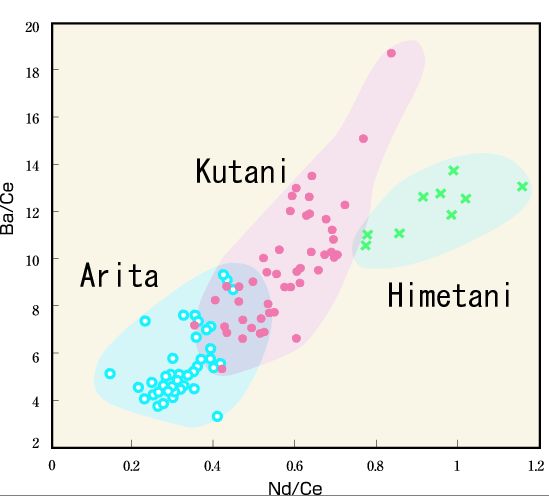
Plot of intensities of Ba, Nd and Ce Ka lines. There is significant difference between three kinds of potteries, made in Arita, Himetani, and Kutani
Scientific keywords
| A. Sample category | inorganic material, organic material |
|---|---|
| B. Sample category (detail) | environmental material |
| C. Technique | fluorescent X-rays |
| D. Technique (detail) | trace-element |
| E. Particular condition | room temperature |
| F. Photon energy | X-ray (> 40 keV) |
| G. Target information | trace element |
Industrial keywords
| level 1---Application area | environment |
|---|---|
| level 2---Target | Environmental material |
| level 3---Target (detail) | ash |
| level 4---Obtainable information | element distribution |
| level 5---Technique |
Inquiry number
SOL-0000001200