Novel Materials Design Approach Achieves a Giant Cooling Effect and Excellent Durability in Magnetic Refrigeration Materials (Press Relese)
- Release Date
- 19 Dec, 2025
- BL02B2 (Powder Diffraction)
- BL25SU (Soft X-ray Spectroscopy of Solid)
December 19, 2025
National Institute for Materials Science (NIMS)
Kyoto Institute of Technology (KIT)
Japan Synchrotron Radiation Research Institute (JASRI)
University of Hyogo
Tohoku University
Technical University of Darmstadt
|
A joint research team from NIMS, Kyoto Institute of Technology (KIT), Japan Synchrotron Radiation Research Institute (JASRI), University of Hyogo, Tohoku University, and the Technical University of Darmstadt, developed a novel materials design approach that achieves a giant cooling effect and excellent durability in magnetic cooling materials whose temperature changes when a magnetic field is switched on and off. |
■ Background
Conventional vapor-compression refrigeration, used in air conditioners, refrigerators, and freezers, raises environmental concerns because it relies on refrigerants with high greenhouse-gas emissions.
As a promising alternative, magnetic cooling has attracted attention because it can operate without such refrigerants.
This technology uses magnetocaloric materials whose temperature changes when a magnetic field is switched on and off.
However, advances in magnetic cooling have long faced a fundamental dilemma: a tradeoff between a giant cooling effect and durability.
In materials that exhibit a giant cooling effect, hysteresis-related energy losses typically lead to performance degradation, making it difficult to sustain the giant effect under operating conditions (i.e., poor cyclic stability).
Conversely, when materials are designed to suppress these losses and achieve good cyclic stability, the magnitude of cooling effect is often reduced, compromising cooling performance for durability (a decline in the cooling effect).
■ Key Findings
The research team developed a materials design approach for intermetallic compounds that can suppress irreversible energy losses by precisely tuning covalent bond through composition control.
To demonstrate this approach, the team focused on an intermetallic Gd5Ge4 compound, composed of Gd (gadolinium) and Ge (germanium).
Gd5Ge4 compound is a magnetic refrigeration material that warms up when a magnetic field is applied, as the Gd spins align.
This magnetic ordering is coupled to a structural transition (i.e., a change in the unit-cell lattice parameters), so the crystal structure differs between the two phases (illustrated by the differently colored Gd spheres in Fig. 1).
The structural transition also changes the bond length between Ge atoms (brown spheres in Fig. 1) that connect the two slabs in the structure, which contributes to hysteresis and performance degradation during repeated cycling.
In this work, the team tuned the covalency by partially substituting Ge atoms with Sn (tin) atoms, thereby suppressing changes in the inter-slab distance during the transition.
As a result, the material maintained a strong cooling response under repeated cycling, and the reversible adiabatic temperature change yielded a twofold increase from 3.8 K to 8 K. This achievement improves both the magnetic cooling effect and its durability of the material, providing a practical route toward sustainable high-performance magnetic refrigerants.
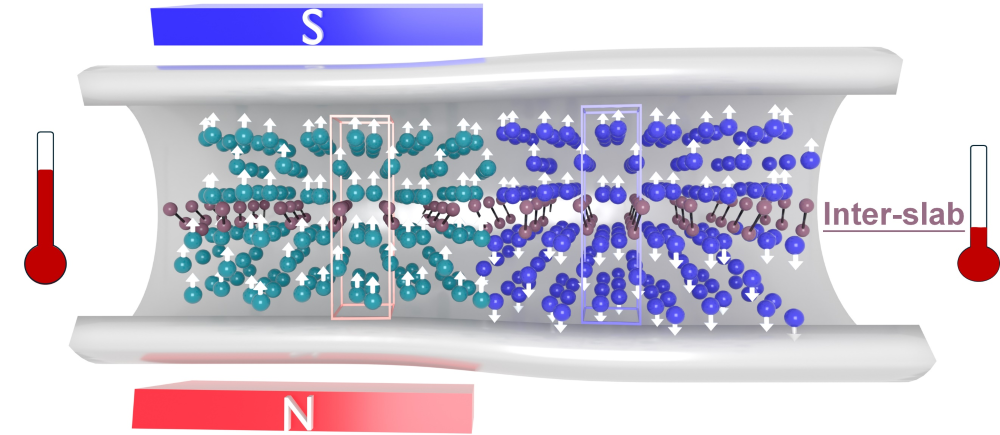
In the absence of an applied magnetic field (right), the spin moments of the Gd atoms (white arrows) in the upper and lower slabs, which are connected by inter-slab Ge atom, are not aligned.
When a magnetic field is applied (left), the spins align, resulting in an increase in temperature.
■ Future Outlook
Because the magnetocaloric materials developed in this research operate in the cryogenic temperature range and exhibit characteristics well suited for hydrogen liquefaction, they are expected to support low-environmental-impact liquid-hydrogen technologies.
In addition, the team has proposed a new design concept for magnetocaloric materials that enables the simultaneous achievement of desirable performance and durability.
In the future, the team will extend this approach to other compounds and expand its scope to a wider range of cooling and gas-liquefaction technologies.
■ Other Information
・This research was conducted by a team consisting of the following researchers: Tang Xin (Senior Researcher, Research Center for Magnetic and Spintronic Materials (CMSM), NIMS); Noriki Terada (Chief Researcher, CMSM, NIMS); Xiao Enda (Postdoctoral Researcher, CMSM, NIMS); Terumasa Tadano (Group Leader, CMSM, NIMS); Andres Martin-Cid (Postdoctoral Researcher, CMSM, NIMS); Tadakatsu Ohkubo (Deputy Director, CMSM, NIMS); Hossein Sepehri-Amin (Group Leader, CMSM, NIMS); Yoshitaka Matsushita (Unit Leader, Research Network and Facility Services Division (RNFS), NIMS); Kazuhiro Hono (Fellow, NIMS); Yoshio Miura (Professor, Kyoto Institute of Technology (KIT)); Takuo Ohkochi (Senior Scientist, Japan Synchrotron Radiation Research Institute (JASRI) (currently Professor, University of Hyogo)); Shogo Kawaguchi (Senior Scientist, JASRI); Shintaro Kobayashi (Research Scientist, JASRI); Tetsuya Nakamura (Professor, International Center for Synchrotron Radiation Innovation Smart, Tohoku University); Allan Döring (PhD Student, Technical University of Darmstadt (TU Darmstadt)); Konstantin Skokov (Senior Researcher, TU Darmstadt); and Oliver Gutfleisch (Professor, TU Darmstadt). The work was supported by the Japan Society for the Promotion of Science (JSPS) International Joint Research Program (JRP-LEAD with DFG; Program No. JPJSJRP20221608), the Japan Science and Technology Agency (JST) ERATO "Uchida Magnetic Thermal Management Materials" (Grant No. JPMJER2201) and Deutsche Forschungsgemeinschaft (DFG) within the CRC/TRR 270 (Project-ID 405553726).
・This research result was published online in Advanced Materials on December 18, 2025.
|
Contact Information |
 ml.nims.go.jp
- Current article
- Novel Materials Design Approach Achieves a Giant Cooling Effect and Excellent Durability in Magnetic Refrigeration Materials (Press Relese)