Charge stripe order
Inquiry number
SOL-0000000892
Beamline
BL02B1 (Single Crystal Structure Analysis)
Scientific keywords
| A. Sample category | inorganic material |
|---|---|
| B. Sample category (detail) | superconductor, solid-state crystal, crystal |
| C. Technique | X-ray diffraction, X-ray elastic scattering |
| D. Technique (detail) | wide angle scattering |
| E. Particular condition | polarization (linear), low-T (~ liquid He) |
| F. Photon energy | X-ray (4-40 keV) |
| G. Target information | structure analysis, crystal structure, structural change, phase transition |
Industrial keywords
| level 1---Application area | electric component, cell (battery), industrial material |
|---|---|
| level 2---Target | rechargeable battery, and solar cell |
| level 3---Target (detail) | electric rod |
| level 4---Obtainable information | crystal structure |
| level 5---Technique | diffraction |
Classification
A80.30 inorganic material, M10.10 single crystal diffraction
Body text
Single crystal x-ray diffraction is a powerful technique to study the periodic arrangement of atoms in materials. Using this technique, one can measure the crystal structure of specimens. By using synchrotron radiation, it can be detected a slight modulation in crystal structure which is never detected by the conventional x-ray source. The figure shows scan profiles of the (1.76, K, 0.5) superlattice reflections of La1.875Ba0.125SrxCuO4. These data provides structural information such as periodicity, propagation direction and correlation length of the charge stripe order which suppresses high-Tc superconductivity. Thereby, it is found that there exists the strong correlation between the charge stripe order pattern and the structural symmetry of the crystal.
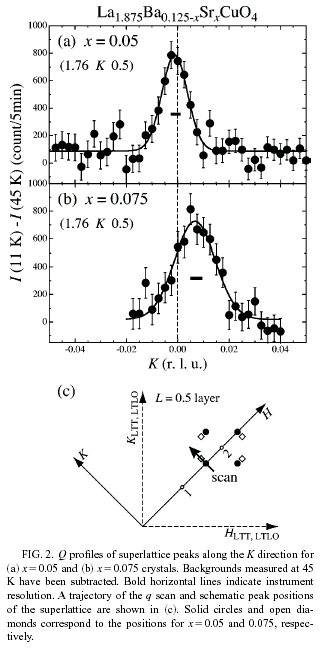
[ H. Kimura, H. Goka, M. Fujita, Y. Noda, L. Yamada and N. Ikeda, Physical Review B 67, 140503(R) (2003), Fig. 2,
©2003 American Physical Society ]
Source of the figure
Original paper/Journal article
Journal title
Phys. Rev. B 67, 140503(R) (2003)
Figure No.
2
Technique
A single crystal diffraction experiment is a powerful technique to study the structure of materials in an atomic scale. The technique is applicable to any crystalline material and provides knowledge about atomic scale structural information.
Source of the figure
No figure
Required time for experimental setup
12 hour(s)
Instruments
| Instrument | Purpose | Performance |
|---|---|---|
| 4-circle diffractometer | diffraction intensity measurement | equiped with refrigerator |
References
| Document name |
|---|
| H. Kimura et. al., Phys. Rev. B 67, 140503 (2003). |
Related experimental techniques
Questionnaire
This solution is an application of a main instrument of the beamline.
Ease of measurement
With a great skill
Ease of analysis
Middle
How many shifts were needed for taking whole data in the figure?
Less than one shift