Direct observation of oxygen molecules physisorbed in nanochannels

Inquiry number
SOL-0000000905
Beamline
BL02B2 (Powder Diffraction)
Scientific keywords
| A. Sample category | organic material |
|---|---|
| B. Sample category (detail) | solid-state crystal, organic material, crystal |
| C. Technique | X-ray diffraction |
| D. Technique (detail) | powder diffraction |
| E. Particular condition | low-T (~ liquid N2), Gas Adsorption |
| F. Photon energy | X-ray (4-40 keV) |
| G. Target information | structure analysis, crystal structure, function and structure, charge density |
Industrial keywords
| level 1---Application area | cell (battery), environment |
|---|---|
| level 2---Target | fuel cell, catalysis |
| level 3---Target (detail) | electric rod |
| level 4---Obtainable information | crystal structure, adsorption |
| level 5---Technique | diffraction |
Classification
A80.14 magnetic materials, A80.32 organic material, A80.40 environmental materials, A80.42 energy, resource, M10.20 powder diffraction
Body text
Powder diffraction is a powerful technique to study crystal structures. Using this technique, one can measure structural parameters such as lattice parameters, atomic positions, etc of crystalline materials. By using synchrotron radiation one can also obtain charge density level structures closely related with physical properties as well as structural parameters. The figure shows charge density distributions obtained by analyzing diffraction data of a metal-organic solid under oxygen gas adsorption. These data reveal the fact that adsorbed oxygen molecules(red color)form a one-dimensional array in the nanochannels.
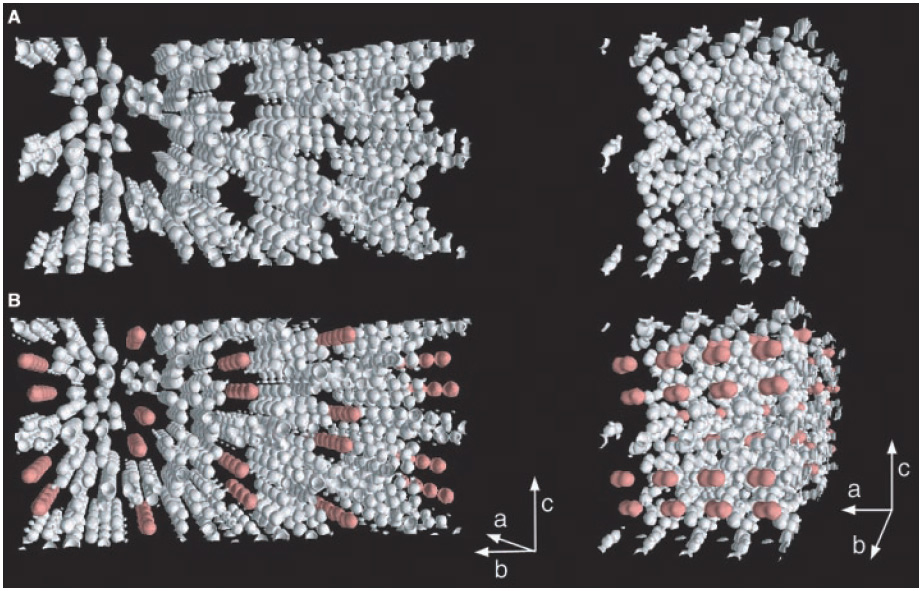
Fig. Charge Densities without O2 molecules (upper) and with adsorbed O2 molecules (lower)in a metal-organic solid.
[ R. Kitaura, S. Kitagawa, Y. Kubota, T. C. Kobayashi, K. Kindo, Y. Mita, A. Matsuo, M. Kobayashi, H.-C. Chang, T. C. Ozawa, M. Suzuki, M. Sakata and M. Takata, Science 298, 2358-2361 (2002), Fig. 3,
©2002 American Association for the Advancement of Science ]
Source of the figure
Original paper/Journal article
Journal title
Science, 298 (2002) 2358.
Figure No.
3
Technique
Synchrotron radiation powder diffraction is a powerful technique to study crystal structures. The technique is applicable to solid-state crystals adsorbing gas molecules and provides knowledge about the structure with adsorbed gas molecules.
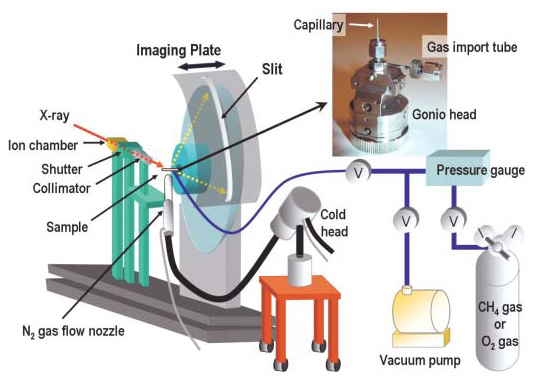
Fig. A large Debye-Scherrer camera with a gas handling system.
Source of the figure
Original paper/Journal article
Journal title
SPring-8 利用者情報, 8 (2003) 406.
Figure No.
2
Required time for experimental setup
1 shift(s)
Instruments
| Instrument | Purpose | Performance |
|---|---|---|
| Large Debye-Scherrer camera | Powder diffraction | Camera radius: 286.48mm, Temperature: 15-1000K |
References
| Document name |
|---|
| R. Kitaura et al., Science, 298 (2002) 2358. |
Related experimental techniques
Single crystal structure analysis
Questionnaire
The measurement was possible only in SPring-8. Impossible or very difficult in other facilities.
This solution is an application of a main instrument of the beamline.
With user's own instruments.
Ease of measurement
With a great skill
Ease of analysis
Middle
How many shifts were needed for taking whole data in the figure?
Four-nine shifts