Observation of nuclear excitation by electron transition in 197Au with a silicon APD electron detector

Inquiry number
SOL-0000001189
Beamline
BL09XU (HAXPES I)
Scientific keywords
| A. Sample category | inorganic material, research on method, instrumentation |
|---|---|
| B. Sample category (detail) | metal, alloy |
| C. Technique | nuclear excitation, Mössbauer effect |
| D. Technique (detail) | |
| E. Particular condition | room temperature, time-resolved (ns) |
| F. Photon energy | X-ray (> 40 keV), gamma ray |
| G. Target information | local structure |
Industrial keywords
| level 1---Application area | others |
|---|---|
| level 2---Target | |
| level 3---Target (detail) | |
| level 4---Obtainable information | |
| level 5---Technique | scattering |
Classification
A80.90 others
Body text
In this solution, 197Au was excited at K absorption Edge to confirm the NEET phenomenon. Nuclear excitation and electronic transition in 197Au have nearly the same energy and a common multipolarity , By detecting the conversion electrons using the Si APD detector, Both the high counting efficiency and good signal to noise ratio were realized. NEET phenomenon was clearly observed for the first time and these data reveal its existence.
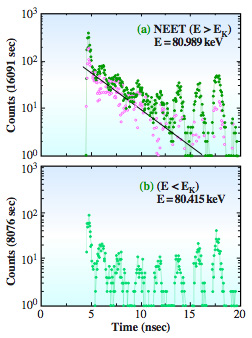
Fig. Time spectra of the internal conversion electrons observed for: (a)NEET the at 80.989 keV (EK, EK: the Au K-shell ionization energy (= 80.725 keV))
during 16091 s; (b) background at 80.415 keV (EK) during 8076 s.
Source of the figure
Bulletin from SPring-8
Bulletin title
Reaearch Frontiers 1998/1999
Page
41
Technique
Source of the figure
No figure
Required time for experimental setup
hour(s)
Instruments
References
| Document name |
|---|
| Phys. Rev. Lett. 85 (2000) 1831 |
Related experimental techniques
Questionnaire
The measurement was possible only in SPring-8. Impossible or very difficult in other facilities.
Ease of measurement
With a great skill
Ease of analysis
With a great skill
How many shifts were needed for taking whole data in the figure?
Four-nine shifts