Measurement of long-lived isotopes using stroboscopic detection of synchrotron radiation

Inquiry number
SOL-0000001188
Beamline
BL09XU (HAXPES I)
Scientific keywords
| A. Sample category | inorganic material, research on method, instrumentation |
|---|---|
| B. Sample category (detail) | metal, alloy |
| C. Technique | nuclear excitation, Mössbauer effect |
| D. Technique (detail) | |
| E. Particular condition | time-resolved (ns), room temperature |
| F. Photon energy | X-ray (4-40 keV) |
| G. Target information | chemical state, chemical bonding, local structure |
Industrial keywords
| level 1---Application area | others |
|---|---|
| level 2---Target | |
| level 3---Target (detail) | |
| level 4---Obtainable information | electronic state, chemical state |
| level 5---Technique | scattering |
Classification
A80.30 inorganic material, A80.40 environmental materials
Body text
Stroboscopic detected Synchrotron Mössbauer Spectroscopy is a unique technique to study the hyperfine interactions of the long-lived isotopes. The technique is applicable to the materials containing Mössbauer nuclei and provides knowledge about the spin orientation, spin strength or the chemical states.
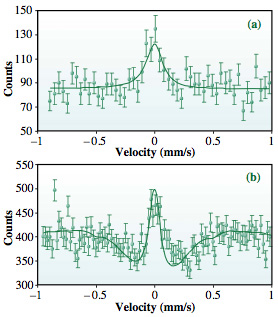
Fig. Stroboscopic spectra of two Ta metal - a bunch-mode of
(a) 203 single bunches and (b) 1/12 filling + 10 single bunches.
Source of the figure
Bulletin from SPring-8
Bulletin title
Reaearch Frontiers 2001B/2002A
Page
46
Technique
Source of the figure
No figure
Required time for experimental setup
2 day(s)
Instruments
References
Related experimental techniques
Questionnaire
The measurement was possible only in SPring-8. Impossible or very difficult in other facilities.
Ease of measurement
With a great skill
Ease of analysis
With a great skill
How many shifts were needed for taking whole data in the figure?
More than ten shifts