X-ray powder diffraction from solid deuterium under pressure


Inquiry number
SOL-0000001121
Beamline
BL10XU (High Pressure Research)
Scientific keywords
| A. Sample category | inorganic material |
|---|---|
| B. Sample category (detail) | crystal, neutral molecule |
| C. Technique | X-ray diffraction |
| D. Technique (detail) | powder diffraction |
| E. Particular condition | microbeam (> 10 µm), high pressure (DAC), low-T (~ liquid N2) |
| F. Photon energy | X-ray (4-40 keV) |
| G. Target information | crystal structure, structural change |
Industrial keywords
| level 1---Application area | cell (battery), industrial material |
|---|---|
| level 2---Target | fuel cell |
| level 3---Target (detail) | |
| level 4---Obtainable information | density, crystal structure, elastic modulus |
| level 5---Technique | diffraction |
Classification
A80.42 energy, resource, M10.20 powder diffraction
Body text
The powder diffraction technique of the BL10XU was applied to hydrogen, that is the most light element . Figure shows the powder diffraction patterns of solid hydrogen (deuterium, D2) were collected at pressure up to 94 GPa and at low-temperature (84K). Reflections from solid deuterium could be recorded as clear diffraction lines on a image-plate detector. The integrated one-dimensional diffraction patterns were well assigned to 100 and 101 lines of hcp structure and the volume compression were observed from these data. Ability of powder diffraction technique also has been proved in this experiment (H. Kawamura et al., Solid State Communication, 119(2001)29).
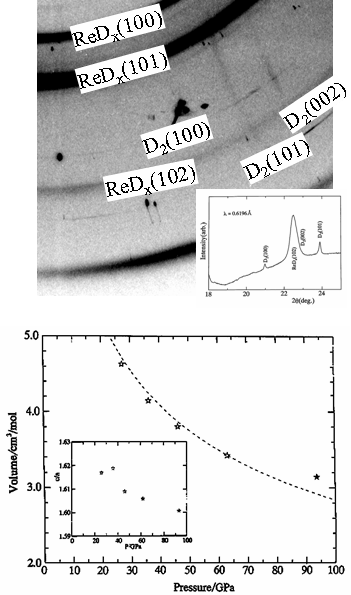
Figure. The diffraction image under pressure (94GPa) and volume compression of D2.
[ H. Kawamura, Y. Akahama,S. Umemoto, K. Takemura, Y. Ohishi and O. Shimomura, Solid State Communication 119, 29-32 (2001), Fig. 3, 4,
©2001 Elsevier Science Publisher ]
Source of the figure
Original paper/Journal article
Journal title
Solid State Comunication, 119(2001)29
Figure No.
3,4
Technique
The high pressure research beamline BL10XU is designed to perform the X-ray diffraction structure analysis under high-pressure and low/high temperature, using the high brilliance X-rays from the in-vacuum type undulator. The monochromatic and focused X-rays irradiate the sample enclosed in a DAC system, which can generate the pressure up to 300 GPa. The most of the conventional limitations (extremely small size sample area (<100mm), limited diffraction windows, x-ray absorption by diamond and so on) for the DAC high pressure diffraction experiment was extended and upgraded to the high resolution, high angular resolution and high counting statistics diffraction experiment as well as rapid data measurement.
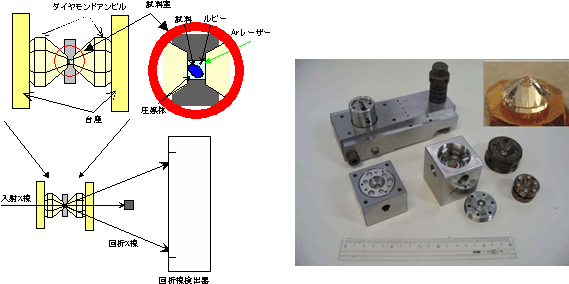
Figure. The diamond anvil cell (DAC)
Source of the figure
Presentation material for Beamline Report
Required time for experimental setup
1 shift(s)
Instruments
| Instrument | Purpose | Performance |
|---|---|---|
| DAC diffractometer | high pressure x-ray diffraction | <300GPa x-ray diffraction measurement |
| DAC cryostat | high pressure/low temperature | 100GPa, 10K |
References
Related experimental techniques
powder x-ray diffraction, single crystal x-ray diffraction, neutron diffraction
Questionnaire
The measurement was possible only in SPring-8. Impossible or very difficult in other facilities.
This solution is an application of a main instrument of the beamline.
Similar experiments account for more than 30% of the beamline's subject.
Ease of measurement
Middle
Ease of analysis
Easy
How many shifts were needed for taking whole data in the figure?
Four-nine shifts