FeSの低温・高圧下での結晶構造相転移
Inquiry number
SOL-0000001321
Beamline
BL10XU (High Pressure Research)
Scientific keywords
| A. Sample category | inorganic material |
|---|---|
| B. Sample category (detail) | metal, alloy, insulator, ceramics, crystal |
| C. Technique | X-ray diffraction |
| D. Technique (detail) | powder diffraction |
| E. Particular condition | high pressure (DAC), low-T (~ liquid He) |
| F. Photon energy | X-ray (4-40 keV) |
| G. Target information | crystal structure, phase transition |
Industrial keywords
| level 1---Application area | electric component, industrial material, others |
|---|---|
| level 2---Target | |
| level 3---Target (detail) | |
| level 4---Obtainable information | electronic state |
| level 5---Technique | diffraction |
Classification
A80.12 semiconductor, A80.14 magnetic materials, M10.20 powder diffraction
Body text
本事例では硫化鉄(FeS)について低温下での高圧X線回折実験を行い、結晶構造の圧力変化を観測しました。BL10XUの低温・高圧実験装置を用れば、試料を17Kまで冷却しDAC(ダイヤモンドアンヴィルセル)で圧力印加しながら、X線回折の強度解析によって結晶構造をその場観察することができます。この実験では、図に示すようなX線回折像の変化が観測され、それぞれ圧力誘起結晶構造相転移が起こっていたことがわかりました。また、2.3GPaでの圧縮曲線の屈曲に対して、電気抵抗の測定と合わせた結果、金属-非金属転移の発生が明らかになりました(H. Kobayashi et al., PRB, 71(2005)014110)。
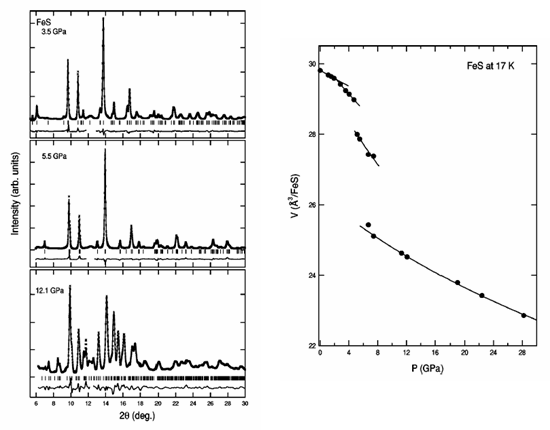
図 FeSの低温/高圧下でのX線回折プロファイルと体積変化
[ H. Kobayashi, T. Kamimura, Y. Ohishi, N. Takeshita and Mori, Physical Review B 71, 014110 (2005), Fig. 1, 2,
©2005 American Physical Society ]
Source of the figure
Original paper/Journal article
Journal title
PRB, 71(2005)014110
Figure No.
1,2
Technique
BL10XUでの低温・高圧下でのX線回折実験は、クライヲスタットの中にダイヤモンドアンヴィルセル(DAC)を封入し、透過窓からX線回折像を測定します。窓はマイラ製で光学的観察が行えるので、低温下においてもルビー蛍光法による試料の圧力測定が可能です。また、DACはHeガス駆動方式です。したがって、試料の温度と圧力が外部から制御でき、広い温度圧力領域(多くの観測点)でのX線回折測定が効率よく実施できます。
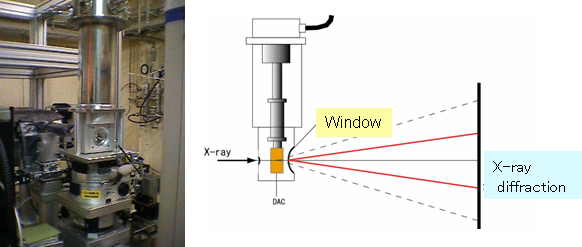
図 BL10XUの低温高圧X線回折装置
Source of the figure
Presentation material for Beamline Report
Required time for experimental setup
1 shift(s)
Instruments
| Instrument | Purpose | Performance |
|---|---|---|
| DAC用クライオスタット | 高圧・低温装置 | 70GPa, 10K |
References
Related experimental techniques
低温高圧での電気抵抗測定、赤外線反射率
Questionnaire
This solution is an application of a main instrument of the beamline.
Ease of measurement
Middle
Ease of analysis
Middle
How many shifts were needed for taking whole data in the figure?
Four-nine shifts