Characterization of SiOx film by GIXS
Inquiry number
SOL-0000000877
Beamline
BL19B2 (X-ray Diffraction and Scattering II)
Scientific keywords
| A. Sample category | inorganic material |
|---|---|
| B. Sample category (detail) | insulator, ceramics, membrane |
| C. Technique | X-ray diffraction |
| D. Technique (detail) | grazing incidence X-ray diffraction/scattering |
| E. Particular condition | room temperature |
| F. Photon energy | X-ray (4-40 keV) |
| G. Target information | structure analysis |
Industrial keywords
| level 1---Application area | Semiconductor, electric component, display |
|---|---|
| level 2---Target | silicon semiconductor, LCD, CD-R、DVD |
| level 3---Target (detail) | gate insulator, interlayer insulator, capacitance insulator, film, lubricant |
| level 4---Obtainable information | structure of non-crystalline material |
| level 5---Technique | GIXS |
Classification
A80.10 electronics, A80.12 semiconductor, M10.30 surface・interface diffraction
Body text
In this solution, grazing incidence X-ray scattering was applied to a thin amorphous SiOx film on Si substrate to analyze atomic alignment (Radial distribution function) of the amorphous film. In grazing incidence X-ray diffraction, incident X-rays are impinged to a sample surface with a very small angle (lower than the critical angle for total reflection) to restrict X-ray penetration depth in some teens nanometers. In this condition, sensitivity to scattered X-rays from sample surface or deposited thin film on substrate is much improved. These data reveal the fact that the SiOx film deposited by ECR sputtering is mixture of amorphous silicon and silicon oxide.
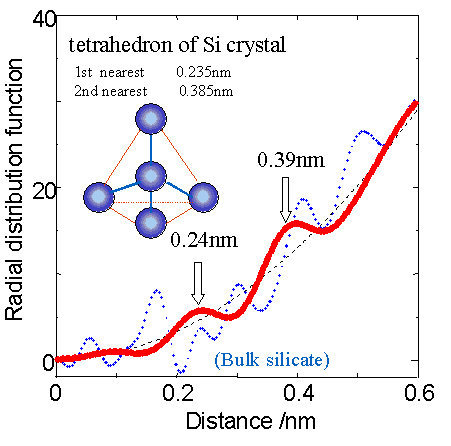
Radial distribution functions of the deposited SiOx film (red curve) and bulk silicate(dotted blue curve).
Source of the figure
Private communication/others
Description
広沢 作成
Technique
Grazing incidence X-ray scattering is performed by observing scattered X-ray profiles reflecting atomic arrangement of thin film on substrate. In this solution, radial distribution function of SiOx on substrate were obtained.
Source of the figure
No figure
Required time for experimental setup
1 shift(s)
Instruments
| Instrument | Purpose | Performance |
|---|---|---|
| Multi-axis diffractometer | diffraction | 4axes and 2axes |
References
| Document name |
|---|
| I.Hirosawa, J. Ceramic Soc. Jpn. 112-1, S1476 (2004). |
Related experimental techniques
Questionnaire
This solution is an application of a main instrument of the beamline.
Ease of measurement
Middle
Ease of analysis
With a great skill
How many shifts were needed for taking whole data in the figure?
Two-three shifts