Mechanism and structure analysis of curing reaction of polymer-modified cement.

Inquiry number
SOL-0000001065
Beamline
BL19B2 (X-ray Diffraction and Scattering II)
Scientific keywords
| A. Sample category | inorganic material |
|---|---|
| B. Sample category (detail) | metal, alloy, macromolecule, crystal |
| C. Technique | X-ray diffraction |
| D. Technique (detail) | powder diffraction |
| E. Particular condition | room temperature |
| F. Photon energy | X-ray (4-40 keV) |
| G. Target information | structure analysis, structural change |
Industrial keywords
| level 1---Application area | construction, Chemical product, industrial material |
|---|---|
| level 2---Target | Concrete |
| level 3---Target (detail) | |
| level 4---Obtainable information | crystal structure |
| level 5---Technique | diffraction |
Classification
A80.30 inorganic material, M10.20 powder diffraction
Body text
The difference of the reaction products by the temperature change and the difference of a reactive speed according to the air-temperature were investigated. From this result the material design according to the on-the-spot request became possible.
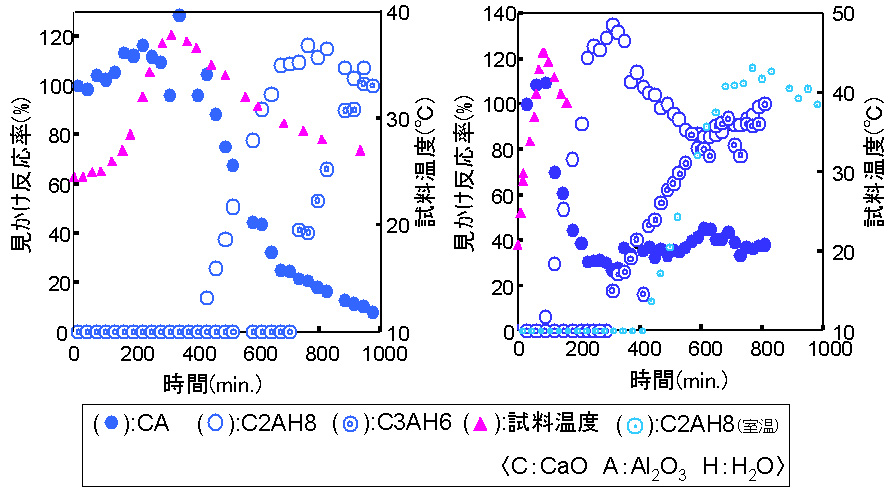
Fig. Air-temperature ; left:room temperature, right: 35 degrees centigrade.
Source of the figure
Private communication/others
Description
大関化学研究所 宮下景子
Technique
Source of the figure
No figure
Required time for experimental setup
0.5 hour(s)
Instruments
| Instrument | Purpose | Performance |
|---|---|---|
| The Large Debye-Scherrer camera | powder diffraction |
References
| Document name |
|---|
| JOURNAL OF THE SOCIETY OF MATERIALS SCIENCE JAPAN Vol.54,No.7,pp.780-784 |
Related experimental techniques
Questionnaire
The measurement was possible only in SPring-8. Impossible or very difficult in other facilities.
This solution is an application of a main instrument of the beamline.
Ease of measurement
Middle
Ease of analysis
Middle
How many shifts were needed for taking whole data in the figure?
Four-nine shifts