Three-dimensional structure of chondrule included in primitive chondrite


問い合わせ番号
SOL-0000001146
ビームライン
BL20B2(医学・イメージングI)
学術利用キーワード
| A. 試料 | 無機材料 |
|---|---|
| B. 試料詳細 | 結晶性固体, 非晶質、ガラス, 結晶 |
| C. 手法 | 吸収、及びその二次過程 |
| D. 手法の詳細 | |
| E. 付加的測定条件 | 三次元画像計測(CT等) |
| F. エネルギー領域 | X線(4~40 keV) |
| G. 目的・欲しい情報 | 形態・巨視的構造 |
産業利用キーワード
| 階層1 | 建設, 環境, 化学製品, 工業材料, その他 |
|---|---|
| 階層2 | |
| 階層3 | |
| 階層4 | 亀裂、空隙, 内部構造 |
| 階層5 | イメージング |
分類
A80.90 その他, M60.20 X線CT
利用事例本文
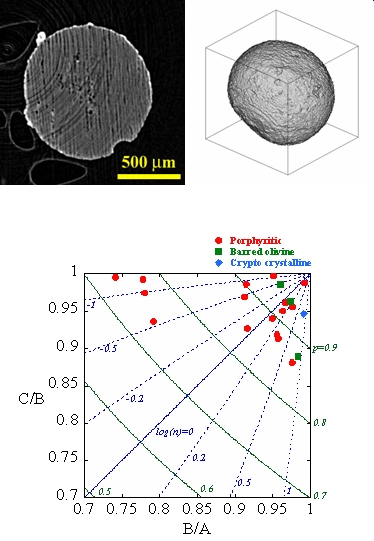
Chondrules are characteristic constituents in primitive chondrites. These tiny spherical objects (0.1 to a few mm in diameter) are mainly composed of silicates. Chondrules were formed in the primordial solar nebula about 4.5 billion years ago prior to the formation of the Earth. They were once molten due to the instantaneous heating of solid precursors and cooled rapidly. X-ray computed tomography (CT) can give information about the internal structure and provide 3-D structures. The figure at upper right is a slice image of a chondrule. The upper left is a bird eye's view of it.
The bottom figure shows the aspect ratios, a/b and b/c, of chondrules. The axial radii, a, b and c, were obtained by ellipsoid fitting for each chondrule. The distributions of voids, metal and sulfide strongly suggest that the chondrule was spinning during their formation in a molten state.
The spinning rate of the chondrules is estimated to be about 50 - 200 rps by considering the balance between the surface tension of droplet chondrules and centrifugal forces.
Such a high spinning rate favors a specific chondrule formation process, such as rotation by drag heating of irregular-shaped dust balls by a shock wave or collision of small heavenly bodies.
[ A. Tsuchiyama, R. Shigeyoshi, T. Kawabata, T. Nakano, K. Uesugi and S. Shirono, Lunar Planeary Science XXXIV, 1271 (2003), Fig. 1,
©2003 Lunar and Planetary Institute ]
画像ファイルの出典
原著論文/解説記事
誌名
A. Tsuchiyama, R. Shigeyoshi, T. Kawabata, T. Nakano, K. Uesugi and S. Shirono (2003) Lunar Planet. Sci., XXXIV, 1271.
図番号
測定手法
画像ファイルの出典
図なし
測定準備に必要なおおよその時間
6 シフト
測定装置
| 装置名 | 目的 | 性能 |
|---|---|---|
| X-ray CT system | obtain internal structure of materials | spatia lreoslution of 10um |
参考文献
| 文献名 |
|---|
| A. Tsuchiyama, R. Shigeyoshi, T. Kawabata, T. Nakano, K. Uesugi and S. Shirono (2003) Lunar Planet. Sci., XXXIV, 1271. |
関連する手法
アンケート
SPring-8だからできた測定。他の施設では不可能もしくは難しい
本ビームラインの主力装置を使っている
測定の難易度
初心者でもOK
データ解析の難易度
中程度
図に示した全てのデータを取るのにかかったシフト数
4~9シフト