Design of materials microstructure by 3-D image-based mechanical simulation using high-resolution X-ray CT


Inquiry number
SOL-0000004513
Beamline
BL20B2 (Medical and Imaging I)
Scientific keywords
| A. Sample category | inorganic material, research on method, instrumentation |
|---|---|
| B. Sample category (detail) | metal, alloy, insulator, ceramics, solid-state crystal |
| C. Technique | absorption and its secondary process |
| D. Technique (detail) | reflection, refraction |
| E. Particular condition | 3D imaging (cf. CT), room temperature, time-resolved (slow) |
| F. Photon energy | X-ray (4-40 keV) |
| G. Target information | local structure, dislocation, strain, structural change, morphology |
Industrial keywords
| level 1---Application area | mechanics, industrial material |
|---|---|
| level 2---Target | Steel |
| level 3---Target (detail) | |
| level 4---Obtainable information | crack, crevice, structure, molphology |
| level 5---Technique | imaging |
Classification
A80.20 metal ・material, A80.30 inorganic material, M60.20 X-ray CT
Body text
In-situ material tests using a synchrotron X-ray CT are new methods to observe fracture behavior of microstructures in materials. The methods are useful to take 3-D sequential images of such fracture behavior. At the beamlines BL47XU and BL20B2, the high-resolution CT system is available to perform 3D high-resolution imaging and sequential observations using an in-situ test rig.
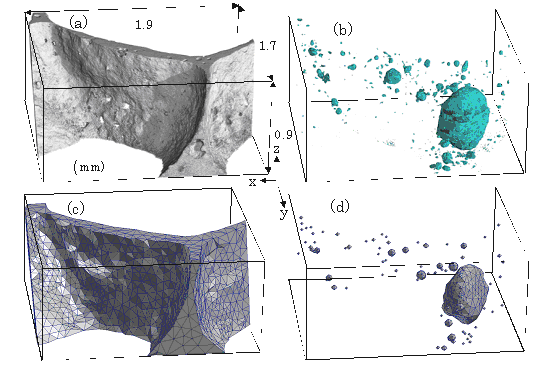
Figure illustrates how an analysis model was created from part of the whole tomographic volume. The polygonal model in the Fig.(c) was extracted from the external form of the cell wall in the aluminum foam in Fig.(a) by a trilinear interpolation. Also the polygonal models of the micropores in Fig.(d) were similarly extracted from the volume in Fig.(b). The methods demonstrated in this study can apply the damage of various materials as well as metals and damage mechanism such as destruction with considerable accuracy can be specified.
Source of the figure
Original paper/Journal article
Journal title
H. Toda, M. Takata, et al. Adv. Engng. Mater. (2006), submitted.
Figure No.
Technique
Source of the figure
No figure
Required time for experimental setup
1 shift(s)
Instruments
| Instrument | Purpose | Performance |
|---|---|---|
| X-ray CT system | obtain 3D structure of materials | spatial resolution of about 10um |
References
| Document name |
|---|
| H. Toda, M. Takata, et al. Adv. Engng. Mater. (2006), submitted. |
| H. Toda, N. Kuroda, et al., Proc. XRM2005, (2005), submitted. |
Related experimental techniques
Questionnaire
The measurement was possible only in SPring-8. Impossible or very difficult in other facilities.
This solution is an application of a main instrument of the beamline.
Ease of measurement
Easy
Ease of analysis
Middle
How many shifts were needed for taking whole data in the figure?
Two-three shifts