ひずみスキャニング法によるショットピーニング材S45Cの表面残留応力測定

Inquiry number
SOL-0000001474
Beamline
BL22XU (JAEA Actinide Science I)
Scientific keywords
| A. Sample category | inorganic material |
|---|---|
| B. Sample category (detail) | metal, alloy |
| C. Technique | X-ray diffraction |
| D. Technique (detail) | powder diffraction |
| E. Particular condition | tensile loading |
| F. Photon energy | X-ray (> 40 keV) |
| G. Target information | dislocation, strain |
Industrial keywords
| level 1---Application area | mechanics, industrial material |
|---|---|
| level 2---Target | Steel |
| level 3---Target (detail) | |
| level 4---Obtainable information | residual stress |
| level 5---Technique | diffraction |
Classification
A80.20 metal ・material
Body text
ひずみスキャニング法は表面から内部のひずみまたは残留応力を調べることのできる有効な手法です。この手法を用いることで、熱による塑性変形をおこしたり表面加工を施した鉄鋼材や、コーティングによる母材との境界面の面内方向のひずみまたは残留応力を測定することができます。この測定手法は従来の応力測定法である2-sin^2法に比べて、非常に手短な時間で測定できること、試料を回転することがないので測定領域を特定することができることなどの特徴があります。図に示すのは、表面にショットピーニングを施したS45Cについて測定した面内方向に応力分布です。この結果から、表面から0.3mmまでの深さにおいて圧縮応力が入っておりそれ以降は無応力であることがわかり、この結果は表面を研磨しながらラボX線で測定した結果とほぼ一致しておりました。
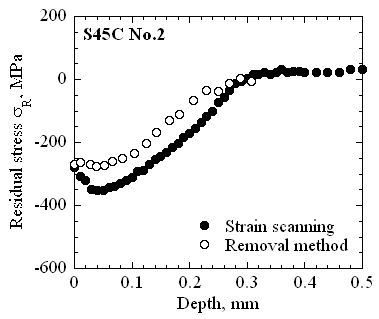
図 ショットピーニングを施したS45C材の残留応力分布
Source of the figure
Private communication/others
Description
shobu@spring8.or.jp
Technique
Source of the figure
No figure
Required time for experimental setup
8 hour(s)
Instruments
| Instrument | Purpose | Performance |
|---|---|---|
| 四軸回折計 | 表面から内部のひずみ取得 | 0.2×2.0mm 10sec/point |
References
Related experimental techniques
Questionnaire
The measurement was possible only in SPring-8. Impossible or very difficult in other facilities.
This solution is application of a new instrument installed in the past two years.
Ease of measurement
Middle
Ease of analysis
Middle
How many shifts were needed for taking whole data in the figure?
Two-three shifts