Tb-Fe-Co 薄膜の元素選択磁気ヒステリシス

Inquiry number
SOL-0000001505
Beamline
BL25SU (Soft X-ray Spectroscopy of Solid)
Scientific keywords
| A. Sample category | research on method, instrumentation |
|---|---|
| B. Sample category (detail) | magnetic material |
| C. Technique | absorption and its secondary process |
| D. Technique (detail) | MCD, LD |
| E. Particular condition | polarization (circular), ultra-high vacuum, surface, high-T (~500 C), low-T (~ liquid N2), low-T (~ liquid He), magnetic field (< 2 T), room temperature |
| F. Photon energy | soft X-ray |
| G. Target information | spin/magnetism |
Industrial keywords
| level 1---Application area | storage device |
|---|---|
| level 2---Target | HD,MO |
| level 3---Target (detail) | magnetic layer, magnetic head, spin valve |
| level 4---Obtainable information | electronic state, magnetic moment, magnetic anisotropy, interface magnetic structure |
| level 5---Technique | XMCD |
Classification
A30.20 surface・interface, A80.14 magnetic materials, A80.30 inorganic material, M40.30 XMCD, M40.40 soft x-ray spectroscopy
Body text
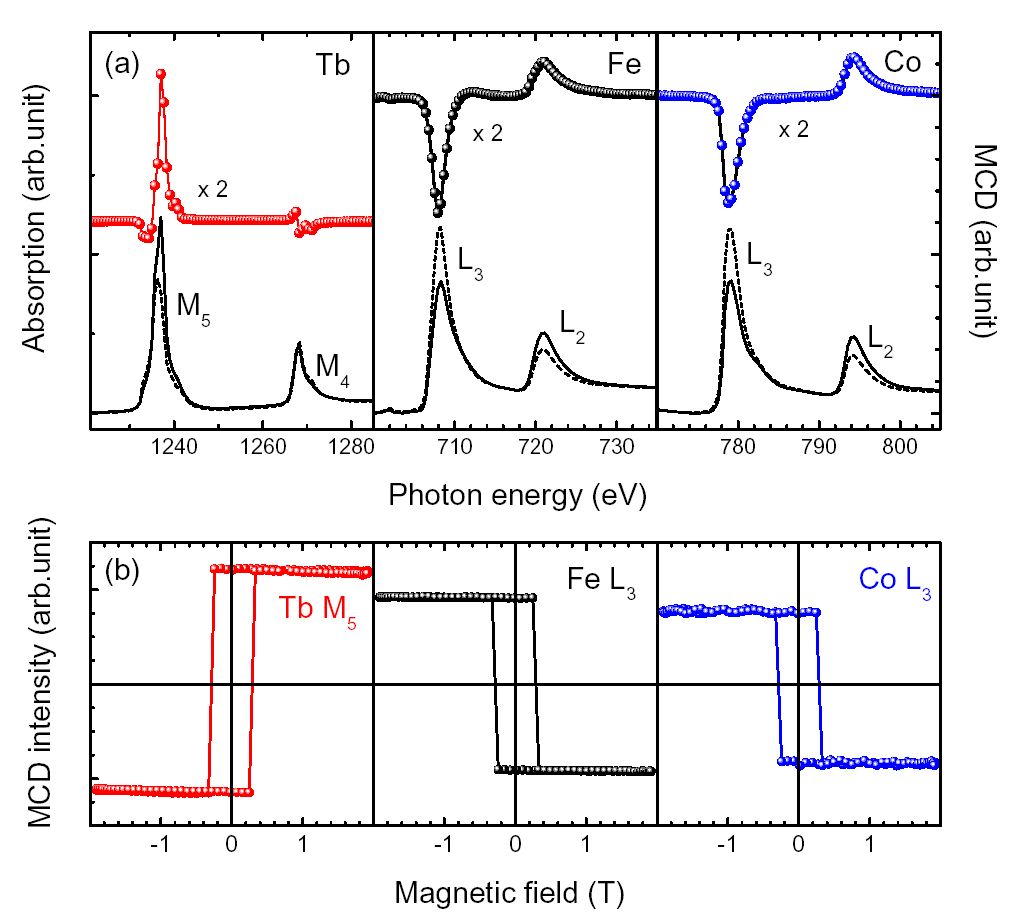
軟X線磁気円二色性(XMCD)は磁気情報を調べることのできる強力な手法です。XMCDスペクトルからは磁性体中の磁性電子の状態や磁気モーメントの大きさを測定することができます。試料が複数の元素から成る合金や化合物であっても、吸収端を選ぶことで元素選択的な磁気情報を取得できることが最大の特徴です。また、軟X線磁気円二色性の強度を試料への印加磁場の関数としてプロットすると、元素選択磁気ヒステリシスが得られます。
図に示すのは、Tb18Fe65.3Co16.7アモルファス合金薄膜について測定した元素選択磁気ヒステリシスです。(a)はTb M4,5, Fe L2,3, Co L2,3各吸収端におけるXMCDスペクトル(黒丸)と左、右回り円偏光に対する吸収曲線(それぞれ、実線と破線)です。(b)は入射X線のエネルギーを各元素吸収端のMCD最大条件に合わせて、MCD強度の磁場依存性を測定した結果(元素選択磁気ヒステリシス)です。この結果から、Tbの磁気モーメントは、FeやCoの磁気モーメントとフェリ磁性結合していることや、その関係を強く保ちつつ外部磁界に対して磁化変化していることが確認されました。この結果はBL25SUにおいて元素選択磁気ヒステリシス測定をデモンストレーションとして試行したものです。
[ T. Nakamura, T. Muro, F.-Z. Guo, T. Matsushita, T. Wakita, T. Hirono, Y. Takeuchi and K. Kobayashi, Journal of Electron Spectroscopy and Related Phenomena 144-147, 1035-1038 (2005), Fig. 3,
©2005 Elsevier Science Publisher ]
Source of the figure
Original paper/Journal article
Journal title
J. Elecron. Spectrosc. and Relat Phenom. 144-147, 1035-1038 (2005).
Figure No.
3
Technique
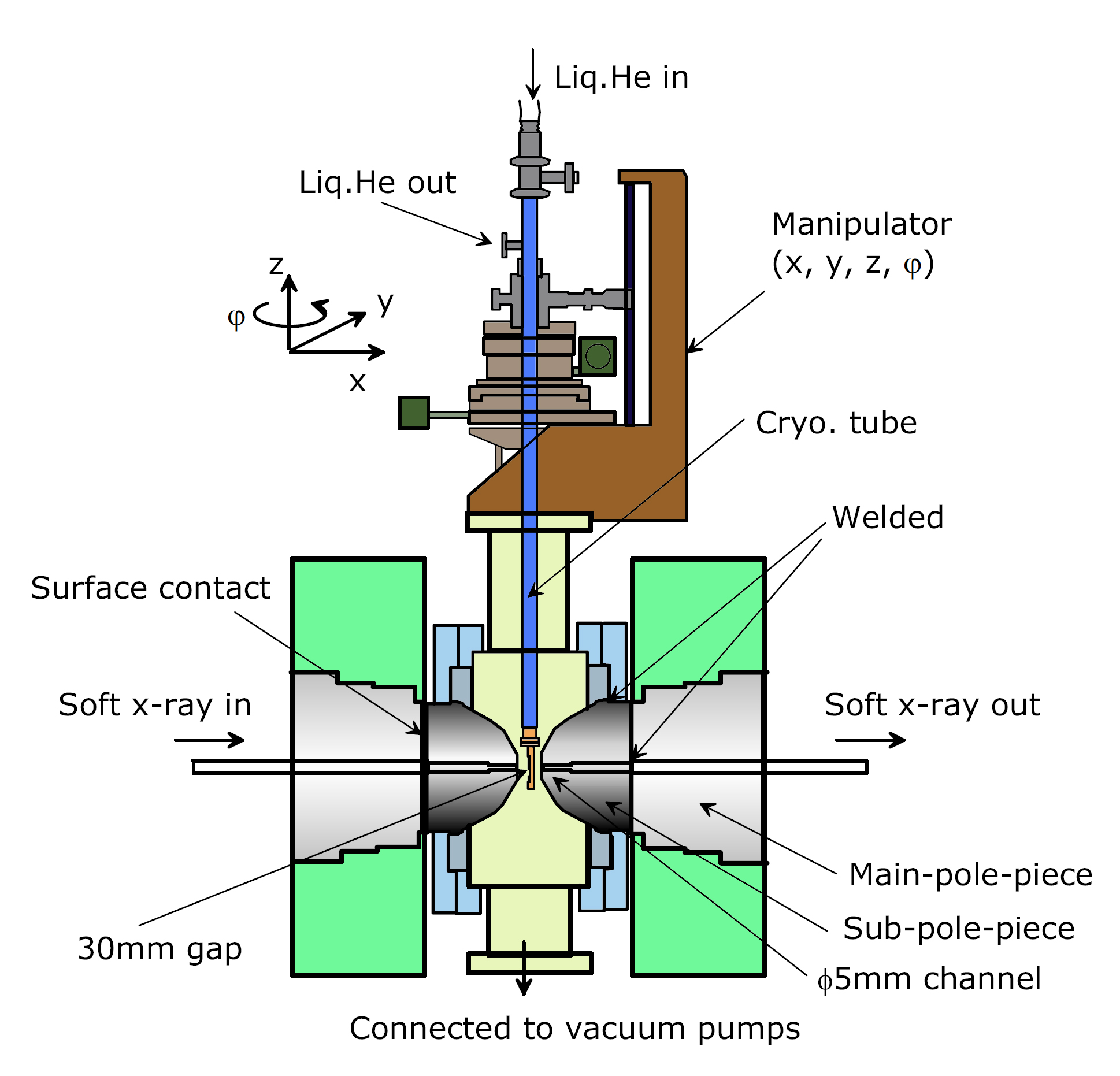
ツインヘリカルアンジュレーターによって右回り円偏光と左回り円偏光を1Hzで周期的に切り替え、それと同期して吸収量を測定することで磁気円二色性を得ています。磁気円二色性スペクトルを得たいときは回折格子角を変化させながら、また、図の磁気ヒステリシスを得たいときには印加磁場を変化させながらXMCD信号を記録します。BL25SUに設置されている電磁石式の磁気円二色性測定装置を用いて測定しました。
[ T. Nakamura, T. Muro, F.-Z. Guo, T. Matsushita, T. Wakita, T. Hirono, Y. Takeuchi and K. Kobayashi, Journal of Electron Spectroscopy and Related Phenomena 144-147, 1035-1038 (2005), Fig. 2,
©2005 Elsevier Science Publisher ]
Source of the figure
Original paper/Journal article
Journal title
J. Elecron. Spectrosc. and Relat Phenom. 144-147, 1035-1038 (2005).
Figure No.
2
Required time for experimental setup
4 hour(s)
Instruments
| Instrument | Purpose | Performance |
|---|---|---|
| 磁気円二色性測定装置 | 軟X線磁気円二色性の測定 | 印加磁場 (±1.9 T), 試料温度 (低温16K ~ 300K, 高温300K ~ 500K)) |
References
| Document name |
|---|
| J. Elecron. Spectrosc. and Relat Phenom. 144-147, 1035-1038 (2005). |
Related experimental techniques
光電子顕微鏡:磁気円二色性を用いたイメージングが可能(ただし、磁場印加は不可)
Questionnaire
This solution is an application of a main instrument of the beamline.
Similar experiments account for more than 30% of the beamline's subject.
This solution is application of a new instrument installed in the past two years.
Ease of measurement
Easy
Ease of analysis
Easy
How many shifts were needed for taking whole data in the figure?
Two-three shifts