Atomic-resolution x-ray holography
Inquiry number
SOL-0000001060
Beamline
BL29XU (RIKEN Coherent X-ray Optics)
Scientific keywords
| A. Sample category | inorganic material |
|---|---|
| B. Sample category (detail) | metal, alloy, semiconductor, insulator, ceramics, crystal |
| C. Technique | absorption and its secondary process, fluorescent X-rays |
| D. Technique (detail) | fluorescent X-ray holography |
| E. Particular condition | 3D imaging (cf. CT), X-ray microscopy |
| F. Photon energy | X-ray (4-40 keV) |
| G. Target information | structure analysis |
Industrial keywords
| level 1---Application area | others |
|---|---|
| level 2---Target | |
| level 3---Target (detail) | |
| level 4---Obtainable information | |
| level 5---Technique | imaging |
Classification
A80.12 semiconductor, A80.20 metal ・material, A80.30 inorganic material, A80.32 organic material
Body text
Atomic-resolution x-ray holography is a unique technique to visualize three-dimensional atomic structure. Using this technique, one can measure local structure around a specific atomic element.
The following figures show a hologram and a three-dimensional reconstruction of a ZnSe sample.
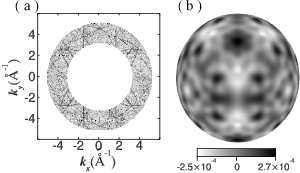
Fig. Hologram of ZnSe
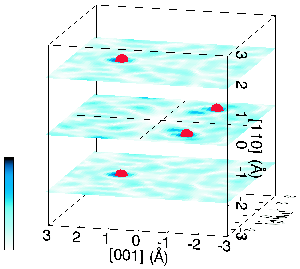
Fig. Three-dimensional reconstruction of ZnSe
[ Y. Nishino, T. Ishikawa, K. Hayashi, Y. Takahashi and E. Matsubara, Physical Review B 66, 092105 (2002), Fig. 3, 4,
©2002 American Physical Society ]
Source of the figure
Original paper/Journal article
Journal title
Y. Nishino, T. Ishikawa, K. Hayashi, Y. Takahashi, and E. Matsubara, Phys. Rev. B 66, 092105 (2002)
Figure No.
3,4
Technique
In internal-detector atomic-resolution x-ray holography, fluorescent x-ray intensities are measured at various incident angles. Fluorescent X-ray spectroscopy is performed using an analyzer crystal or an energy dispersive x-ray detector.
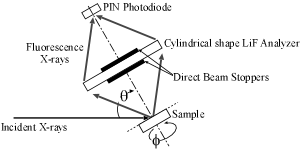
Fig. Schematic view of atomic-resolution x-ray holography instrument
[ Y. Nishino, T. Ishikawa, K. Hayashi, Y. Takahashi and E. Matsubara, Physical Review B 66, 092105 (2002), Fig. 2,
©2002 American Physical Society ]
Source of the figure
Original paper/Journal article
Journal title
Y. Nishino, T. Ishikawa, K. Hayashi, Y. Takahashi, and E. Matsubara, Phys. Rev. B 66, 092105 (2002)
Figure No.
2
Required time for experimental setup
12 hour(s)
Instruments
References
| Document name |
|---|
| Y. Nishino, T. Ishikawa, K. Hayashi, Y. Takahashi, and E. Matsubara, Phys. Rev. B 66, 092105 (2002) |
Related experimental techniques
Questionnaire
With user's own instruments.
Ease of measurement
With a great skill
Ease of analysis
With a great skill
How many shifts were needed for taking whole data in the figure?
More than ten shifts