Induced Cu polarizations in exchange-coupled Co/Cu multilayers

Inquiry number
SOL-0000001082
Beamline
BL39XU (X-ray Absorption and Emission Spectroscopy)
Scientific keywords
| A. Sample category | inorganic material |
|---|---|
| B. Sample category (detail) | magnetic material, synthetic multilayer |
| C. Technique | X-ray diffraction |
| D. Technique (detail) | magnetic scattering |
| E. Particular condition | polarization (circular), room temperature, magnetic field (< 2 T) |
| F. Photon energy | X-ray (4-40 keV) |
| G. Target information | spin/magnetism |
Industrial keywords
| level 1---Application area | storage device |
|---|---|
| level 2---Target | HD,MO |
| level 3---Target (detail) | magnetic layer, magnetic head, spin valve |
| level 4---Obtainable information | magnetic moment, interface magnetic structure |
| level 5---Technique | magnetic scattering, magnetic Compton scattering, PEEM |
Classification
A80.14 magnetic materials, M25.10 magnetic scattering
Body text
Resonant X-ray magnetic scattering is a unique technique to study the magnetization distribution inside a layered magnetic film. Using this technique, one can measure the magnetization depth profile of each layer of magnetic multilayers consisting of 3d transition metals or rare-earth metals. Sensitivity of the technique is so high that a profile of small magnetization induced in a non-magnetic layer, such as Cu, can be determined. The figure shows magnetic scattering peaks of an exchange-coupled [Co(1.25 nm)/Cu(3.88 nm)]50 multilayer. These data indicate that magnetization of the Co layer is even distribution, while magnetization of the Cu layer is oscillatory damping as the distance from the interface.
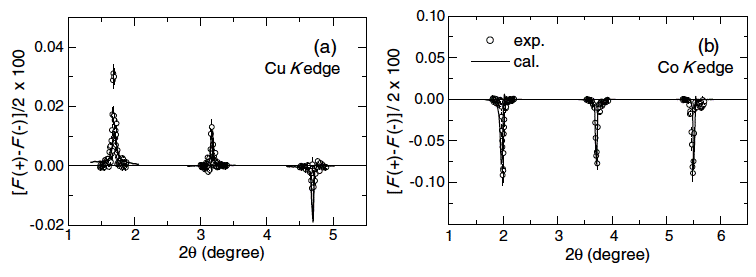
Fig. Resonant X-ray magnetic scattering peaks in an exchange-coupled [Co(1.25 nm)/Cu(3.88 nm)]50 multilayer.
[ Y. Hayasaki, K. Ishiji, H. Hashizume, N. Hosoito, K. Omote, M. Kuribayashi, G. Srajer, J. C. Lang and D. Haskel, Journal of Physics :Condensed Matter 16, 1915-1925 (2004), Fig. 10,
©2004 Institute of Physics and IOP Publishing, Ltd. ]
Source of the figure
Original paper/Journal article
Journal title
Y. Hayasaki et al., J. Phys.: Condens. Matter 16, 1915 (2004).
Figure No.
Fig. 10
Technique
Resonant X-ray magnetic scattering signals are recorded by monitoring a small difference in the diffraction intensities between for right- and left-circularly polarized X-rays. In this solution, X-ray energy is tuned to the K edge (Co: 7723 eV and Cu: 8992 eV) of each elements to obtain magnetic scattering peaks for Co and Cu.
Source of the figure
No figure
Required time for experimental setup
2 shift(s)
Instruments
| Instrument | Purpose | Performance |
|---|---|---|
| Two-axes diffractometer | Resonant X-ray magnetic scattering measurements | Angular resolution 0.36 arcsec/step, four-circle goniometer |
References
| Document name |
|---|
| Y. Hayasaki, K. Ishiji, H. Hashizume, N. Hosoito, K. Omote, M. Kuribayashi, G. Srajer, J. C. Lang, and D. Haskel, J. Phys.: Condens. Matter 16, 1915 (2004). |
Related experimental techniques
XMCD, X-ray magnetic circular dichroism, element-specific magnetometry, magnetoresistance measurements, SQUID magnetometry, VSM magnetometry
Questionnaire
The measurement was possible only in SPring-8. Impossible or very difficult in other facilities.
With user's own instruments.
Ease of measurement
Middle
Ease of analysis
With a great skill
How many shifts were needed for taking whole data in the figure?
Four-nine shifts