Density measurement of micro-meteorites using micro-tomography

Inquiry number
SOL-0000001148
Beamline
BL47XU (Micro-CT)
Scientific keywords
| A. Sample category | inorganic material |
|---|---|
| B. Sample category (detail) | solid-state crystal, amorphous, glass, crystal, mineral,rock |
| C. Technique | absorption and its secondary process |
| D. Technique (detail) | |
| E. Particular condition | 3D imaging (cf. CT) |
| F. Photon energy | X-ray (4-40 keV) |
| G. Target information | morphology |
Industrial keywords
| level 1---Application area | construction, others |
|---|---|
| level 2---Target | Concrete |
| level 3---Target (detail) | |
| level 4---Obtainable information | density, crack, crevice, structure, molphology |
| level 5---Technique | imaging |
Classification
A80.90 others, M60.20 X-ray CT
Body text
Extraterrestrial materials of 1 mm in size are called as cosmic dust in contrast to meteorites (1 mm). They are classified into cosmic spherules, micrometeorites (MMs) and interplanetary dust particles (IDPs). MMs are irregular shaped particles of a few 10s to a few 100s um in size and collected from snow and ice in the polar region.
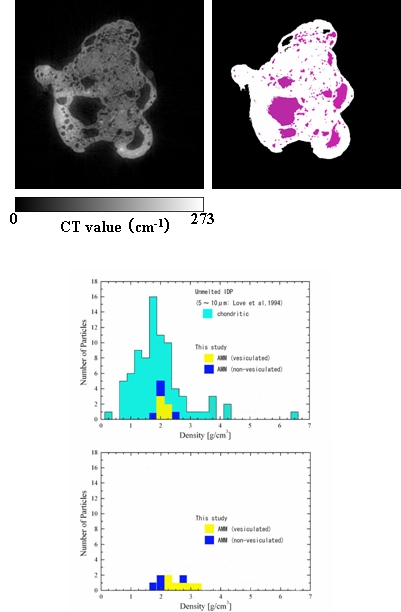
Density is one of the most important parameter, however, it is difficult to measure precisely such as small materials. Therefore an ultra micro-balance and micro-tomography were used to measure their weight and volume (Figure upper left: CT image, upper right: solid region (white) and internal voids region (magenta)).
The bulk density including the volume of internal voids and solid density not including the volume of internal voids were obtained (bottom figures). The solid density of heated sample is different from non-heated sample during entry to the atmosphere.
This method will be applied to the sample of HAYABUSA mission. HAYABUSA's mission: to bring back samples from an asteroid and investigate the mysteries of the birth of the solar system.
[ Meteoritics and Planetary Science 39, A107 (2004),
©2004 Meteoritical Society ]
Source of the figure
Original paper/Journal article
Journal title
A. Tsuchiyama, T. Okazawa, T. Noguchi, H. Yano, T. Osawa, T. Nakamura, K. Nakamura, T. Nakano, K. Uesugi, and H. Yasuda (2004) Meteor. Plant. Sci., 39, Suppl. A107.
Figure No.
Technique
Source of the figure
No figure
Required time for experimental setup
1 shift(s)
Instruments
| Instrument | Purpose | Performance |
|---|---|---|
| X-ray CT system | obtain internal structure of materials | spatial resolutin of about 1µm |
References
| Document name |
|---|
| A. Tsuchiyama, T. Okazawa, T. Noguchi, H. Yano, T. Osawa, T. Nakamura, K. Nakamura, T. Nakano, K. Uesugi, and H. Yasuda (2004) Meteor. Plant. Sci., 39, Suppl. A107. |
Related experimental techniques
Questionnaire
The measurement was possible only in SPring-8. Impossible or very difficult in other facilities.
This solution is an application of a main instrument of the beamline.
Ease of measurement
Middle
Ease of analysis
Middle
How many shifts were needed for taking whole data in the figure?
Four-nine shifts