微弱超格子反射の観測:電荷ストライプ秩序の存在解明
Inquiry number
SOL-0000001261
Beamline
BL02B1 (Single Crystal Structure Analysis)
Scientific keywords
| A. Sample category | inorganic material |
|---|---|
| B. Sample category (detail) | superconductor, solid-state crystal, crystal |
| C. Technique | X-ray diffraction, X-ray elastic scattering |
| D. Technique (detail) | wide angle scattering |
| E. Particular condition | polarization (linear), low-T (~ liquid He) |
| F. Photon energy | X-ray (4-40 keV) |
| G. Target information | structure analysis, crystal structure, structural change, phase transition |
Industrial keywords
| level 1---Application area | electric component, cell (battery), industrial material |
|---|---|
| level 2---Target | rechargeable battery, and solar cell |
| level 3---Target (detail) | electric rod |
| level 4---Obtainable information | crystal structure |
| level 5---Technique | diffraction |
Classification
A80.30 inorganic material, M10.10 single crystal diffraction
Body text
単結晶回折実験は物質中の原子の周期的配列を調べることのできる強力な手法です。この手法を用いることで、 物質の結晶構造を測定することができます。放射光を利用することにより、実験室の装置では検出できない振幅の小さな変調構造を捉えることが可能になります。図に示すのは、La1.875Ba0.125SrxCuO4について測定した(1.76, K, 0.5)超格子反射の回折曲線です。この結果から、超伝導相の出現を抑制する電荷ストライプ秩序の周期・伝播方向・相関長といった構造情報が明らかにされ、結晶の対称性との間に強い相関関係があることがわかりました。
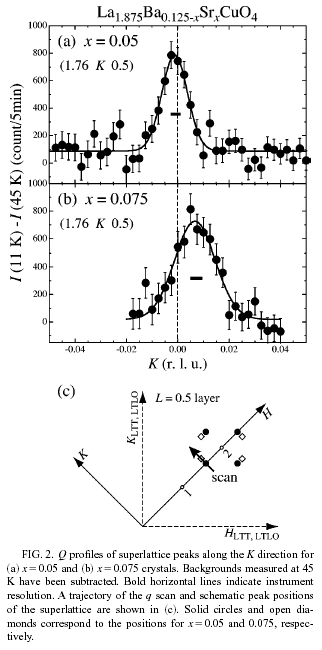
[ H. Kimura, H. Goka, M. Fujita, Y. Noda, L. Yamada and N. Ikeda, Physical Review B 67, 140503(R) (2003), Fig. 2,
©2003 American Physical Society ]
Source of the figure
Original paper/Journal article
Journal title
Phys. Rev. B 67, 140503(R) (2003)
Figure No.
2
Technique
単結晶回折実験は、物質の構造を原子的尺度で調べられる強力な測定方法です。この方法は、結晶であればどんな物質にも適用でき、原子レベルの構造を解明することができます。
Source of the figure
No figure
Required time for experimental setup
12 hour(s)
Instruments
| Instrument | Purpose | Performance |
|---|---|---|
| 4軸回折計 | 回折強度測定 | 冷凍機搭載 |
References
| Document name |
|---|
| H. Kimura et. al., Phys. Rev. B 67, 140503 (2003). |
Related experimental techniques
中性子線回折
Questionnaire
This solution is an application of a main instrument of the beamline.
Ease of measurement
With a great skill
Ease of analysis
Middle
How many shifts were needed for taking whole data in the figure?
Less than one shift