Covalent bond in ferroelectric PbTiO3

Inquiry number
SOL-0000000954
Beamline
BL02B2 (Powder Diffraction)
Scientific keywords
| A. Sample category | inorganic material |
|---|---|
| B. Sample category (detail) | ferroelectric material, solid-state crystal, crystal |
| C. Technique | X-ray diffraction |
| D. Technique (detail) | powder diffraction |
| E. Particular condition | high-T (~500 C), high-T (> 500 C), room temperature |
| F. Photon energy | X-ray (4-40 keV) |
| G. Target information | chemical bonding, structure analysis, crystal structure, structural change, function and structure, charge density, phase transition |
Industrial keywords
| level 1---Application area | Semiconductor, electric component |
|---|---|
| level 2---Target | silicon semiconductor, condenser |
| level 3---Target (detail) | capacitance insulator |
| level 4---Obtainable information | crystal structure |
| level 5---Technique | diffraction |
Classification
A80.30 inorganic material, M10.20 powder diffraction
Body text
Powder diffraction is a powerful technique to study crystal structures. Using this technique, one can measure structural parameters such as lattice parameters, atomic positions, etc of crystalline materials. By using synchrotron radiation one can also obtain charge density level structures closely related with physical properties as well as structural parameters. The figure shows charge density distributions obtained by analyzing diffraction data of ferroelectric PbTiO3. These data reveal the fact that the Pb-O hybridization is a key factor of much larger ferroelectricity of this substance.

Fig. Charge densities of the paraelectric (left) and ferroelectric phase (right) in PbTiO3
[ Y. Kuroiwa, A. Sawada and S. Aoyagi, Solid State Physics 38, 488-496 (2003), Fig. 3,
©2003 AGNE GIJUTSU CENTER ]
Source of the figure
Presentation material for Beamline Report
Technique
Powder diffraction using synchrotron radiations a powerful technique to study crystal structures. The technique is applicable to materials with Pb atom which is one of typical heavy atoms and provides knowledge about atomic position and bonding nature for the materials.
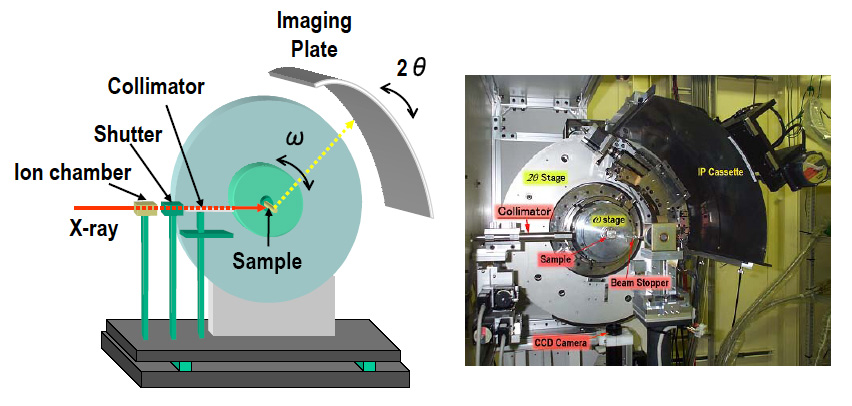
Fig. A large Debye-Scherrer camera.
Source of the figure
Presentation material for Beamline Report
Required time for experimental setup
1 hour(s)
Instruments
| Instrument | Purpose | Performance |
|---|---|---|
| Large Debye-Scherrer camera | Powder diffraction | Camera radius: 286.48mm, Temperature: 15-1000K |
References
| Document name |
|---|
| Y. Kuroiwa et al., Physical Review Letters, 87 (2001) 217601. |
Related experimental techniques
Single crystal structure analysis
Questionnaire
The measurement was possible only in SPring-8. Impossible or very difficult in other facilities.
This solution is an application of a main instrument of the beamline.
Similar experiments account for more than 30% of the beamline's subject.
Ease of measurement
Middle
Ease of analysis
Middle
How many shifts were needed for taking whole data in the figure?
Two-three shifts