シアノ錯体における電荷移動の直接観察

Inquiry number
SOL-0000001268
Beamline
BL02B2 (Powder Diffraction)
Scientific keywords
| A. Sample category | inorganic material |
|---|---|
| B. Sample category (detail) | magnetic material, solid-state crystal, crystal |
| C. Technique | X-ray diffraction |
| D. Technique (detail) | powder diffraction |
| E. Particular condition | low-T (~ liquid N2), room temperature |
| F. Photon energy | X-ray (4-40 keV) |
| G. Target information | chemical bonding, structure analysis, crystal structure, structural change, function and structure, charge density, phase transition |
Industrial keywords
| level 1---Application area | storage device |
|---|---|
| level 2---Target | HD,MO, CD-R、DVD |
| level 3---Target (detail) | magnetic layer |
| level 4---Obtainable information | interatomic distance, crystal structure, valence |
| level 5---Technique | diffraction |
Classification
A80.14 magnetic materials, M10.20 powder diffraction
Body text
粉末回折法は 結晶構造を調べることのできる強力な手法です。この手法を用いることで、結晶性物質の 原子位置、格子定数などを測定することができます。また、放射光を利用することによって、構造パラメータだけではなく結合状態や価数といった物性の発現と密接に関連した電子密度レベルでの構造を明らかにすることも可能です。図に示すのは、光誘起磁性を示すシアノ錯体RbMn[Fe(CN)6]について測定した回折データを解析して得られた電子密度分布です。この結果から、磁化率の変化に伴うMnサイトからFeサイトへの電荷移動がわかりました。

図 RbMn[Fe(CN)6]における室温(左)と電荷移動後の低温(右)の電子密度分布
Source of the figure
Private communication/others
Description
BL担当自身が作成。
Technique
放射光を用いた粉末回折法は、結晶構造を調べられる強力な測定方法です。この方法は、電子密度レベルでの構造解析にも適用でき、原子の価数の変化に関する情報を得ることができます。
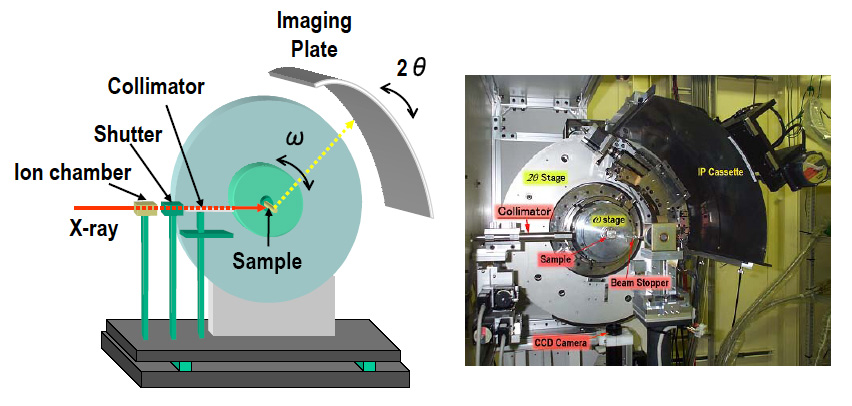
図 大型デバイシェラーカメラの模式図(左)と写真(右)
Source of the figure
Presentation material for Beamline Report
Required time for experimental setup
1 hour(s)
Instruments
| Instrument | Purpose | Performance |
|---|---|---|
| 大型デバイシェラーカメラ | 粉末結晶構造解析 | カメラ半径:286.48mm, 温度:15-1000K |
References
| Document name |
|---|
| K. Kato et al., Physical Review Letters, 91 (2003) 255502. |
Related experimental techniques
単結晶構造解析
Questionnaire
The measurement was possible only in SPring-8. Impossible or very difficult in other facilities.
This solution is an application of a main instrument of the beamline.
Similar experiments account for more than 30% of the beamline's subject.
Ease of measurement
Middle
Ease of analysis
Middle
How many shifts were needed for taking whole data in the figure?
Two-three shifts