Kinetics of mineral transformation

Inquiry number
SOL-0000001134
Beamline
BL04B1 (High Temperature and High Pressure Research)
Scientific keywords
| A. Sample category | inorganic material |
|---|---|
| B. Sample category (detail) | crystal |
| C. Technique | X-ray diffraction |
| D. Technique (detail) | powder diffraction |
| E. Particular condition | high pressure (press), tensile loading, high-T (> 500 C), time-resolved (ms) |
| F. Photon energy | X-ray (> 40 keV) |
| G. Target information | crystal structure, structural change, phase transition |
Industrial keywords
| level 1---Application area | industrial material |
|---|---|
| level 2---Target | |
| level 3---Target (detail) | |
| level 4---Obtainable information | d-spacing (lattice parameter), crystal structure |
| level 5---Technique | diffraction |
Classification
A60.20 environment, A80.30 inorganic material, M10.20 powder diffraction
Body text
Energy-dispersive X-ray diffraction using a large-volume press, SPEED-1500 is a powerful tool for the direct research on the structure and properties of materials in the Earths interior under high-pressure and high-temperature condition. Since the strong white X-ray beam make it possible to take the X-ray diffraction pattern in a very short time (few seconds), the ratio of the phase transformation can be determined from the time-resolving data collection. Figure shows changes of X-ray diffraction patterns during the - transformation in Mg2SiO4 olivine. Nucleation and growth kinetics of the transformation of mantle mineral can be estimated from the integrated intensities of the diffraction peak. The kinetic study provides the significant information of the dynamics in the Earth interior, which includes those relevant to the mechanism of earthquake, generation of magmas, and penetration of slabs.
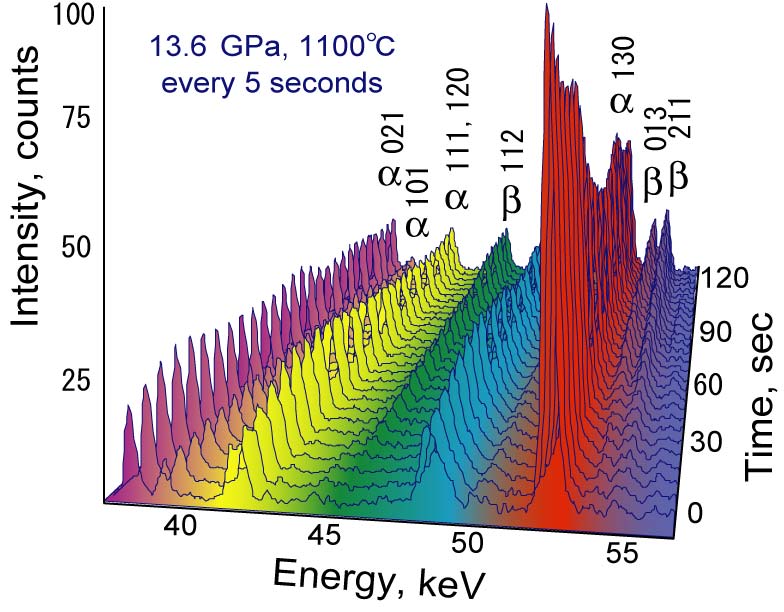
Fig. Changes of X-ray diffraction patterns during the - transformation in Mg2SiO4.
[ K. Funakoshi, W. Utsumi, O. Ohtaka, T. Irifune, T. Inoue. E. Ito, T. Katsura, A. Kubo, K. Hirose, J. Ando, A. Suzuki, T. Kubo and H. Terasaki, Japanese Magazine of Mineralogical and Petrological Sciences 30, 102-103 (2001), Fig. 2,
©2001 The Mineralogical Society of Japan ]
Source of the figure
Original paper/Journal article
Journal title
岩石鉱物科学, 20, 102(2001)
Figure No.
2
Technique
An energy-dispersive X-ray diffraction system attached to the Kawai-type large-volume press is shown in figure. A white X-ray beam from the bending magnet light source is collimated with vertical and horizontal slits to form a thin beam possessing a cross section of typically 0.05 x 0.1 mm2. In order to carry out the energy-dispersive X-ray diffraction on the Kawai-type system, the first-stage anvils are cut holes to pass the X-ray beam. The incident white X-ray beam from the first-stage passes through the gaps between the second-stage anvils in a horizontal plane. X-rays diffracted by samples under high-pressure and high-temperature is detected by a pure Ge solid state detector (Ge-SSD) with a 4096 multi-channel analyzer. Diffraction data can be obtained with an energy range from 20 to 150 keV. Use of a collimator (0.05 mm width) and a receiving slit at a fixed angle to the direct beam permits only the diffracted X-rays from the sample to be detected. The horizontal goniometer covers a range of 2θ angles from -10 to 23° with an accuracy of 0.0001°. The X-ray acquisition time to obtain a diffraction profile is typically one to several minutes.
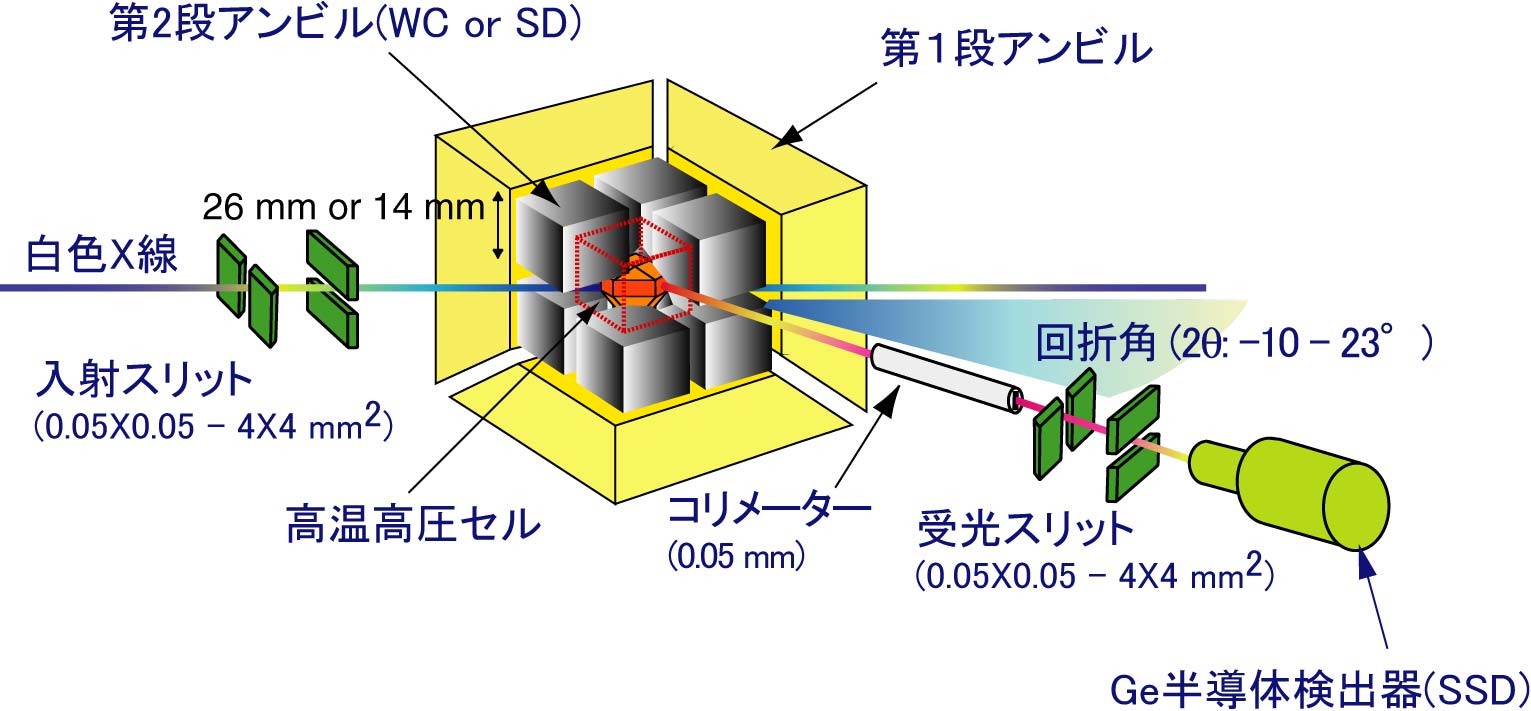
Fig. Schematic drawing of the energy-dispersive X-ray diffraction on the Kawai-type large-volume press
Source of the figure
Beamline Report
Page
14
Required time for experimental setup
2 hour(s)
Instruments
| Instrument | Purpose | Performance |
|---|---|---|
| SPEED-1500 | High pressure and high temperature experiment | 2500K, 30 GPa |
References
| Document name |
|---|
| T. Kubo, Am. Mineral., 89, 285(2004) |
Related experimental techniques
Questionnaire
The measurement was possible only in SPring-8. Impossible or very difficult in other facilities.
This solution is an application of a main instrument of the beamline.
Ease of measurement
With a great skill
Ease of analysis
With a great skill
How many shifts were needed for taking whole data in the figure?
Two-three shifts