Orbital state in colossal materials Fe1-xCuxCr2S4


Inquiry number
SOL-0000001169
Beamline
BL08W (High Energy Inelastic Scattering)
Scientific keywords
| A. Sample category | inorganic material |
|---|---|
| B. Sample category (detail) | metal, alloy, magnetic material, solid-state crystal |
| C. Technique | inelastic scattering |
| D. Technique (detail) | magnetic scattering, Compton scattering |
| E. Particular condition | polarization (circular), low-T (~ liquid He), magnetic field (> 2 T) |
| F. Photon energy | X-ray (> 40 keV) |
| G. Target information | electronic state, spin/magnetism |
Industrial keywords
| level 1---Application area | electric component, storage device |
|---|---|
| level 2---Target | HD,MO |
| level 3---Target (detail) | magnetic layer, magnetic head |
| level 4---Obtainable information | electronic state, magnetic moment, magnetic anisotropy |
| level 5---Technique | magnetic scattering, magnetic Compton scattering, PEEM |
Classification
A80.14 magnetic materials, M25.10 magnetic scattering
Body text
Magnetic Compton scattering is an unique technique to study magnetic compounds. Using this technique, one can measure the spin-dependent electron momentum distribution in ferro- and ferrimagnetic compounds. When the MCP can be decomposed into a few partial profiles with the characteristic shape of a specific electronic state, the area under the partial profile gives the partial spin moment associated with that state. The figure shows the magnetic Compton profiles of FeCr2S4. These data reveal the fact that the Fe spin moments were aligned anti-parallel to that of Cr.
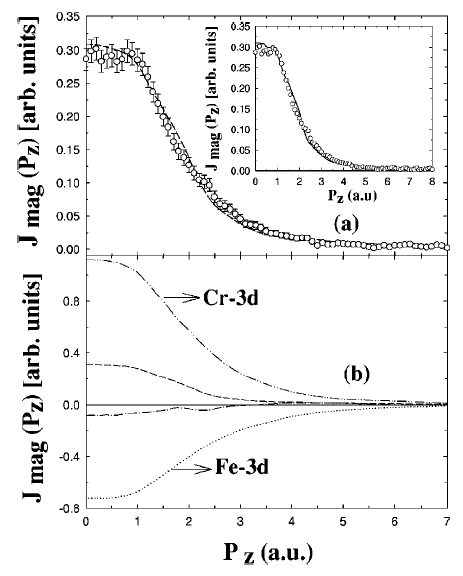
Fig. (a) The experimental magnetic Compton profile (MCP) (circle) and calculated FLAPW-GGA MCP (dashed line) for FeCr2S4. (b) The theoretical MCP along with the contributions from the Fe-3d orbital and Cr-3d orbital.
[ A. Deb, N. Hiraoka, M. Itou, Y. Sakurai, H. M. Palmer and C. Greaves, Physical Review B 66, 100407 (2002), Fig. 1,
©2002 American Physical Society ]
Source of the figure
Original paper/Journal article
Journal title
A. Deb et. al., Physical Review B, 66 (2002) 100407
Figure No.
1
Technique
When the incident x-rays are circularly polarized, the scattering cross-section contains a spin-dependent term. The experimental extraction of the spin dependence results in a magnetic Compton profile (MCP), Jmag(pz), that is defined as the one-dimensional projection of the spin-polarized electron momentum distribution. The area under the MCP is equal to the total spin moment (μspin) per formula unit.
where n↑(p) and n↓(p) are the momentum densities of the majority and minority spin bands, respectively.
Source of the figure
No figure
Required time for experimental setup
4 hour(s)
Instruments
| Instrument | Purpose | Performance |
|---|---|---|
| Magnetic Compton Scattering Spectrometer | Magnetic Compton measurement | momentum resolution 0.5 atomic unit |
References
| Document name |
|---|
| A. Deb et. al., Physical Review B, 66 (2002) 100407 |
Related experimental techniques
Questionnaire
The measurement was possible only in SPring-8. Impossible or very difficult in other facilities.
This solution is an application of a main instrument of the beamline.
Similar experiments account for more than 30% of the beamline's subject.
Ease of measurement
Easy
Ease of analysis
Middle
How many shifts were needed for taking whole data in the figure?
Four-nine shifts