陶磁器の微量分析測定

Inquiry number
SOL-0000001305
Beamline
BL08W (High Energy Inelastic Scattering)
Scientific keywords
| A. Sample category | inorganic material, organic material |
|---|---|
| B. Sample category (detail) | environmental material |
| C. Technique | fluorescent X-rays |
| D. Technique (detail) | trace-element |
| E. Particular condition | room temperature |
| F. Photon energy | X-ray (> 40 keV) |
| G. Target information | trace element |
Industrial keywords
| level 1---Application area | environment |
|---|---|
| level 2---Target | Environmental material |
| level 3---Target (detail) | ash |
| level 4---Obtainable information | element distribution |
| level 5---Technique |
Classification
A60.20 environment, A80.30 inorganic material, A80.32 organic material, A80.40 environmental materials
Body text
蛍光X線分析は物質に含まれる元素組成を調べることのできる簡便な手法です。この手法は、非破壊であり、また、100keVを超える高エネルギーX線を使用することで、希土類などの重元素の組成分析に敏感です。
図に示すのは、陶磁器について測定した希土類の組成比です。この結果から、産地によりその組成比に特徴があることがわかりました。
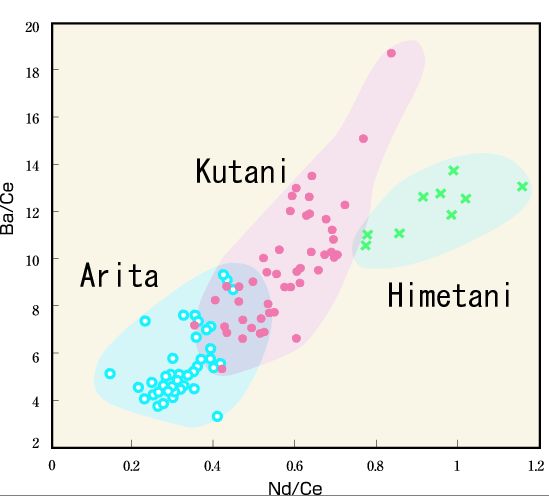
有田、九谷、姫谷産の陶磁器の測定結果。蛍光X線測定による各希土類のピーク強度比の分布図
Source of the figure
Bulletin from SPring-8
Bulletin title
Spring-8 News, 6 (2001)
Page
Technique
試料に高エネルギーX線を入射し、散乱角90度に設置したGe-半導体検出器で蛍光X線をエネルギー分光します。
Source of the figure
No figure
Required time for experimental setup
4 hour(s)
Instruments
| Instrument | Purpose | Performance |
|---|---|---|
| 高エネルギー蛍光X線スペクトロメーター | 蛍光X線分析 |
References
| Document name |
|---|
| Spring-8 News, 6 (2001) |
Related experimental techniques
Questionnaire
With user's own instruments.
Ease of measurement
Easy
Ease of analysis
Easy
How many shifts were needed for taking whole data in the figure?
Four-nine shifts