Structural properties of FeS under high pressure and low temperature
Inquiry number
SOL-0000001106
Beamline
BL10XU (High Pressure Research)
Scientific keywords
| A. Sample category | inorganic material |
|---|---|
| B. Sample category (detail) | metal, alloy, insulator, ceramics, crystal |
| C. Technique | X-ray diffraction |
| D. Technique (detail) | powder diffraction |
| E. Particular condition | high pressure (DAC), low-T (~ liquid He) |
| F. Photon energy | X-ray (4-40 keV) |
| G. Target information | crystal structure, phase transition |
Industrial keywords
| level 1---Application area | electric component, industrial material, others |
|---|---|
| level 2---Target | |
| level 3---Target (detail) | |
| level 4---Obtainable information | electronic state |
| level 5---Technique | diffraction |
Classification
A80.12 semiconductor, A80.14 magnetic materials, M10.20 powder diffraction
Body text
The structural properties of FeS at low temperature and under pressures were studied by the x-ray diffraction on BL10XU. FeS undergoes two successive first order structural phase transitions. Figure shows typical observed x-ray diffraction patterns below and above 5 GPa, which gave fits to the troilite and MnP-type structures, respectively. Furthermore, it is found that there is a knee in the pressure dependence of volume in the troilite structure which is correspond to the semiconductor-metal transition. The transition is almost continues at 2.5 GPa and 17 K because there is a volume reduction less than 0.1% at the transition (H. Kobayashi et al., PRB, 71(2005)014110).
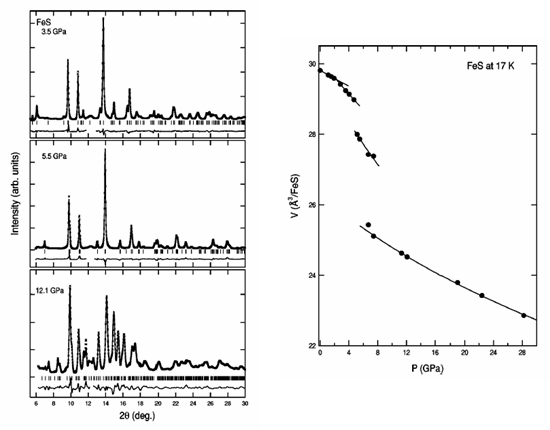
Figure. Typical x-ray diffraction profiles of FeS under high pressure (at 17K)
and pressure dependence of volume V.
[ H. Kobayashi, T. Kamimura, Y. Ohishi, N. Takeshita and Mori, Physical Review B 71, 014110 (2005), Fig. 1, 2,
©2005 American Physical Society ]
Source of the figure
Original paper/Journal article
Journal title
PRB, 71(2005)014110
Figure No.
1,2
Technique
The He flow type cryostat for the DAC can be mounted on the BL10XU's diffractometer for low temperature experiments down to 10 K as shown in figure. Combining the on-line pressure measurement system described above with a He-gas driven DAC, in which the pressure can be controlled remotely, one can conduct high- pressure experiment at low temperature very efficiently.
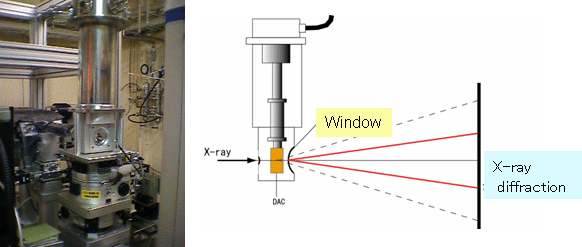
Figure. Cryostat and DAC of BL10XU
Source of the figure
Presentation material for Beamline Report
Required time for experimental setup
1 shift(s)
Instruments
| Instrument | Purpose | Performance |
|---|---|---|
| DAC cryostat | high pressure/low temperature | 70GPa, 10K |
References
Related experimental techniques
Questionnaire
This solution is an application of a main instrument of the beamline.
Ease of measurement
Middle
Ease of analysis
Middle
How many shifts were needed for taking whole data in the figure?
Four-nine shifts