High energy XPS analysis on chemical reaction of catalytic Fe on Si : catalysis of carbon nanotube
Inquiry number
SOL-0000004528
Beamline
BL15XU (RIKEN Materials Science III)
Scientific keywords
| A. Sample category | inorganic material |
|---|---|
| B. Sample category (detail) | metal, alloy, semiconductor |
| C. Technique | photoemission, photoionization |
| D. Technique (detail) | photoelectron spectra |
| E. Particular condition | high-T (> 500 C) |
| F. Photon energy | X-ray (4-40 keV) |
| G. Target information | chemical state, chemical bonding, function |
Industrial keywords
| level 1---Application area | display, Chemical product, industrial material |
|---|---|
| level 2---Target | PDP、FED, fuel cell, catalysis |
| level 3---Target (detail) | |
| level 4---Obtainable information | electronic state, chemical state |
| level 5---Technique | XPS |
Classification
M50.10 photoelectron spectroscopy
Body text
High energy XPS is a powerful tool to analyze the bulk chemical or electronic structure. It is well-known that carbon nanotube is synthesized by use of Fe and Co catalytic particles and these particles on Si substrate is useful to produce nano-wire. High energy XPS has revealed that Si oxide on Si substrate to prevent Fe silicide formation and its workings is depending on substrate temperature.
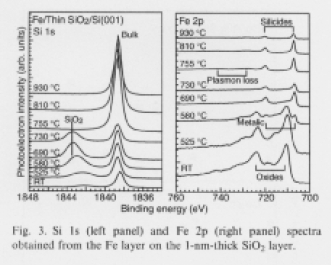
[ F. Maeda, E. Laffosse, Y. Watanabe, S. Suzuki, Y. Homma, M. Suzuki, T. Kitada, T. Ogiwara, A. Tanaka, M. Kimura, V. A. Mihai, H. Yohsikawa and S. Fukushima, Physica E 24, 19-25 (2004), Fig. 3,
©2004 Elsevier Science Publisher ]
Source of the figure
Original paper/Journal article
Journal title
Phisica E 24 (2004) 19-25
Figure No.
Fig3
Technique
High energy XPS is a powerful tool to analyze the bulk chemical or electronic structure.
Source of the figure
No figure
Required time for experimental setup
1 shift(s)
Instruments
| Instrument | Purpose | Performance |
|---|---|---|
| High energy XPEEM | bulk sensitive chemical imaging | maximum phoelectrons' energy 4.8keV |
References
| Document name |
|---|
| Physica E24 (2004) 19-25 |
Related experimental techniques
Questionnaire
This solution is an application of a main instrument of the beamline.
Ease of measurement
Middle
Ease of analysis
Middle
How many shifts were needed for taking whole data in the figure?
Two-three shifts