High energy XPS interface analysis of magnetic tunnel junction device
Inquiry number
SOL-0000004529
Beamline
BL15XU (RIKEN Materials Science III)
Scientific keywords
| A. Sample category | inorganic material |
|---|---|
| B. Sample category (detail) | metal, alloy, insulator, ceramics |
| C. Technique | photoemission, photoionization |
| D. Technique (detail) | photoelectron spectra |
| E. Particular condition | interface |
| F. Photon energy | intermediate (2-4 keV), X-ray (4-40 keV) |
| G. Target information | chemical state, chemical bonding |
Industrial keywords
| level 1---Application area | storage device |
|---|---|
| level 2---Target | HD,MO |
| level 3---Target (detail) | magnetic head |
| level 4---Obtainable information | chemical state |
| level 5---Technique | XPS |
Classification
M50.10 photoelectron spectroscopy
Body text
High energy XPS is useful to analyse chemical states and electronic structure without surface cleaning owing to its long observation depth.
Magnetic tunnel junction device has a sandwich structure of a ferromagnetic layer and an insulating tunneling layer. In this work, high energy XPS can clarify the chemical states at the interface of the ferromagnetic layer and the insulating layer. Left figure shows the survey XPS spectra of one side of magnetic tunnel device with Mg X-ray tube and 3keV SR. This figure indicates that Mn 2p peak of SR survey spectrum in PtMn deep layer is visible and it can be concluded that high energy XPS spectrum has long observation depth. Right figure shows angle-resolved high energy XPS reveals that Fe was easily preferentially oxide at the deep interface of the FeCo layer and alumina insulating layer.
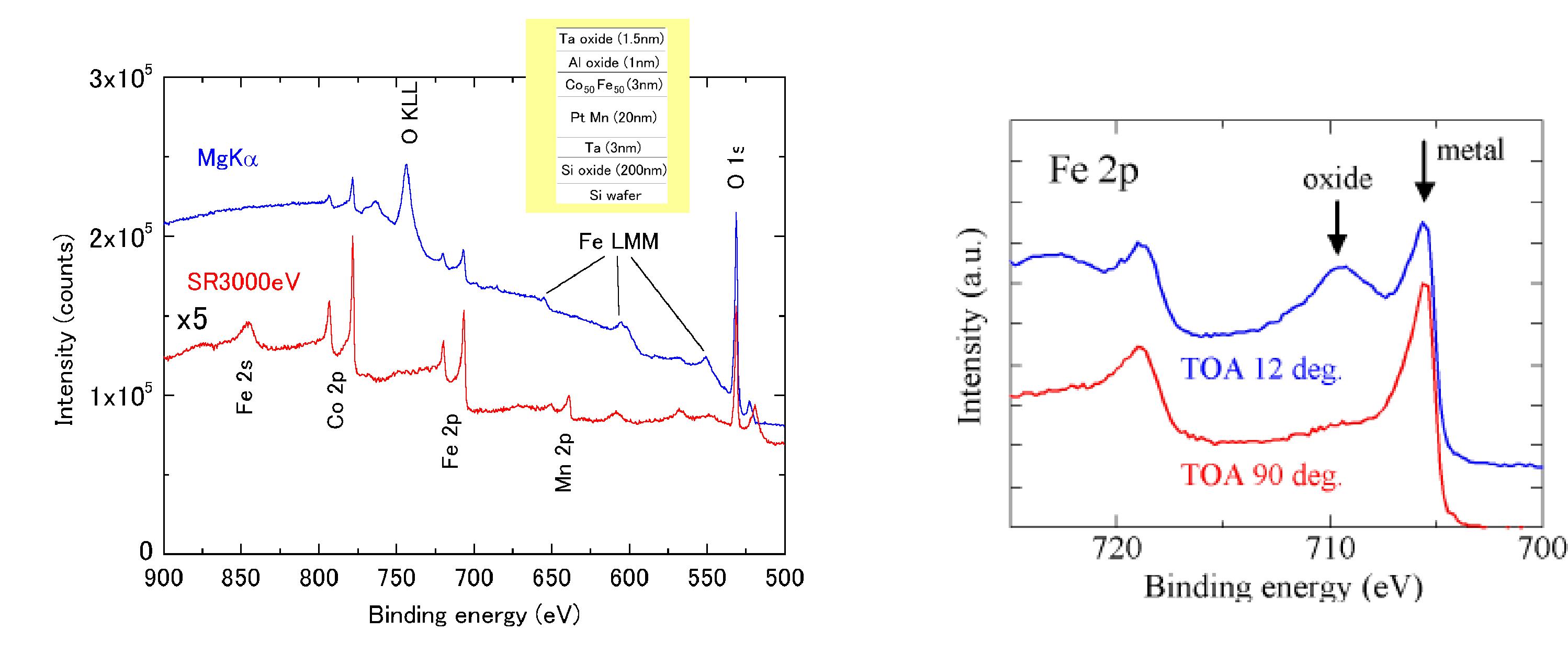
[ H. Yoshikawa, Y. Kita, K. Watanabe, A. Tanaka, M. Kimura, A. Nisawa, A. M. Vlaicu, M. Kitamura, N. Yagi, M. Okui, M. Taguchi, R. Oiwa and S. Fukushima, Journal of Surface Analysis 9, 374-377 (2002), Fig. 5, 6,
©2002 Surface Analysis Society of Japan ]
Source of the figure
Original paper/Journal article
Journal title
Journal of Surface Analysis 9 (2002) 374-377
Figure No.
Fig.5, Fig.6
Technique
High energy XPS is useful to analyse chemical states and electronic structure without surface cleaning owing to its long observation depth.
Source of the figure
No figure
Required time for experimental setup
hour(s)
Instruments
| Instrument | Purpose | Performance |
|---|---|---|
| High energy XPEEM | bulk sensitive chemical analysis | maximum phoelectrons' energy 4.8keV |
References
| Document name |
|---|
| Journal of Surface Analysis 9 (2002) 374-377 |
Related experimental techniques
Questionnaire
This solution is an application of a main instrument of the beamline.
Ease of measurement
Middle
Ease of analysis
Middle
How many shifts were needed for taking whole data in the figure?
Less than one shift