Oxidation reaction dynamics at Cu(001) surface by supersonic oxygen molecular beam

Inquiry number
SOL-0000000966
Beamline
BL23SU (JAEA Actinide Science II)
Scientific keywords
| A. Sample category | inorganic material |
|---|---|
| B. Sample category (detail) | metal, alloy |
| C. Technique | photoemission, photoionization |
| D. Technique (detail) | photoelectron spectra |
| E. Particular condition | ultra-high vacuum, surface, interface, room temperature |
| F. Photon energy | soft X-ray |
| G. Target information | chemical state, chemical bonding, structural change |
Industrial keywords
| level 1---Application area | Semiconductor, cell (battery) |
|---|---|
| level 2---Target | silicon semiconductor, rechargeable battery, and solar cell, catalysis |
| level 3---Target (detail) | wire |
| level 4---Obtainable information | film thickness, surface,interface, adsorption, valence, chemical state |
| level 5---Technique | XPS |
Classification
A30.20 surface・interface, A40.40 surface・interface chemistry, A80.10 electronics, A80.12 semiconductor, A80.30 inorganic material, A80.34 catalysis, A80.42 energy, resource, M50.10 photoelectron spectroscopy
Body text
In this solution, in-situ photoemission spectroscopy was applied to Cu(001) surface to analyze oxygen uptake curves depending on translational kinetic energy of incident oxygen molecules. The translational kinetic energy of incident beam is one of reaction controlling parameters for surface oxidation. These data reveal the fact that an oxygen molecular beam with 2.3 eV incident energy contributes to faster adsorption up to 0.5 monolayer and also further adsorption compared with exposure to oxygen gas ambience.
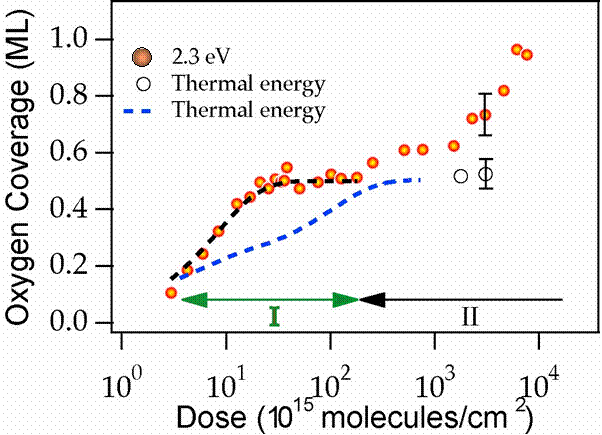
O1s XPS intensity dependence on oxygen dose
Orange circles indicate an oxygen uptake curve in the oxygen incident energy of 2.3 eV.
Open circles and dashed line indicate an oxygen uptake curve in the exposure to oxygen gas.
[ Y. Teraoka, A. Yoshigoe, K. Moritani, Y. Takakuwa, S. Ogawa, S. Ishidzuka, M. Okada, T. Fukuyama and T. Kasai, Journal of the Japanese Society for Synchrotron Radiation Research 18, 298-309 (2005), Fig. 6,
©2005 The Japanese Society for Synchrotron Radiation Research ]
Source of the figure
Original paper/Journal article
Journal title
J. Jpn. Soc. Synch. Rad. Res., Vol.18, No.5, 298 (2005)
Figure No.
Fig.6
Technique
In-situ photoemission spectroscopy is performed by measuring photoemission spectra for Cu(001) sample surface reacted with oxygen gas and supersonic oxygen molecular beam without taking out the sample from a vacuum vessel. In this solution, by observing photoemission spectra step-by-step after irradiation of the supersonic oxygen molecular beam with up to 2.3 eV onto the Cu(001) surface, translational kinetic energy dependence of oxygen uptake curves were obtained.
Source of the figure
No figure
Required time for experimental setup
24 hour(s)
Instruments
| Instrument | Purpose | Performance |
|---|---|---|
| Surface chemical reaction analysis apparatus | In-situ photoemission spectroscopy for chemical reaction dynamics study | Up to 2.3 eV incident energy for oxygen molecules |
References
| Document name |
|---|
| 放射光、Vol.18、No.5、277 (2005) |
Related experimental techniques
XANES, AES, LEED, TPD
Questionnaire
The measurement was possible only in SPring-8. Impossible or very difficult in other facilities.
This solution is an application of a main instrument of the beamline.
Similar experiments account for more than 30% of the beamline's subject.
Ease of measurement
Middle
Ease of analysis
With a great skill
How many shifts were needed for taking whole data in the figure?
More than ten shifts