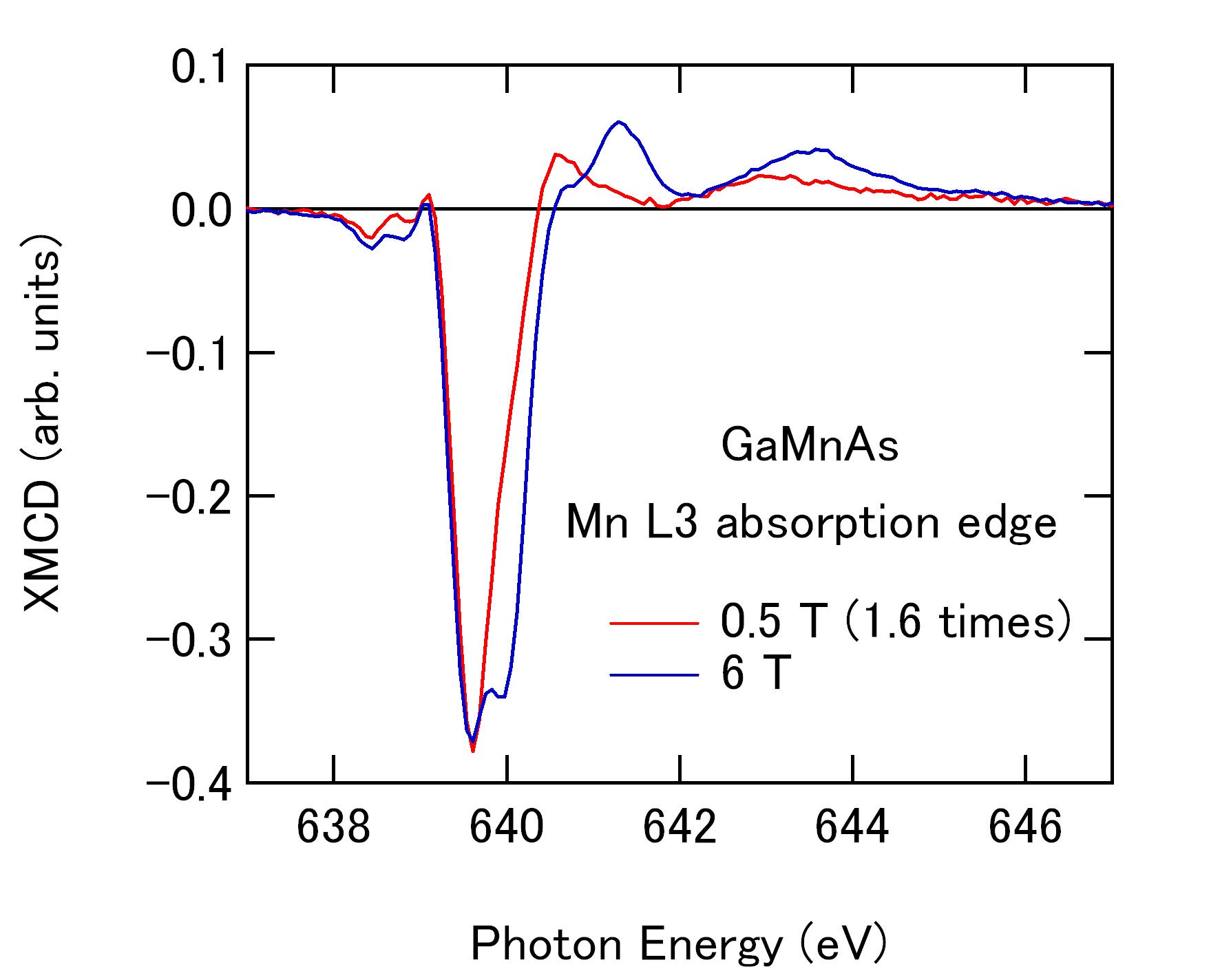
Magnetic field dependence of XMCD of dilute magnetic semiconductors


Inquiry number
SOL-0000001014
Beamline
BL23SU (JAEA Actinide Science II)
Scientific keywords
| A. Sample category | inorganic material |
|---|---|
| B. Sample category (detail) | magnetic material |
| C. Technique | absorption and its secondary process |
| D. Technique (detail) | MCD, LD |
| E. Particular condition | polarization (circular), ultra-high vacuum, low-T (~ liquid He), magnetic field (> 2 T) |
| F. Photon energy | soft X-ray |
| G. Target information | spin/magnetism |
Industrial keywords
| level 1---Application area | storage device |
|---|---|
| level 2---Target | HD,MO |
| level 3---Target (detail) | magnetic layer |
| level 4---Obtainable information | magnetic moment |
| level 5---Technique | XMCD |
Classification
A80.14 magnetic materials, M40.40 soft x-ray spectroscopy
Body text
Soft X-ray Magnetic Circular Dichroism (XMCD) is a very powerful technique for measuring magnetic properties of materials, allowing separate and quantitative measurements on spin and orbital magnetic moments. Using soft x-ray source, the direct information on spin electronic states can be investigated for the 3d states of transition metal compounds and the 4f states of rare-earth compounds. One can change the temperature of a sample and the external magnetic field. Figure shows one example of XMCD spectra measured for GaMnAs. The spectral feature changes when the magnetic field increases from 0.5 T to 6 T, indicating that the Mn ions in GaMnAs have two different sites at least.
Source of the figure
Private communication/others
Description
Technique
Soft x-ray magnetic circular dichroism (XMCD) is defined as a subtraction spectrum between the absorption spectra measured with right and left circular lights under external magnetic field. Two absorption spectra for right and left circular lights are hence acquired in order to obtain one XMCD spectrum. Since the characteristic energy of x-ray absorption edge depends on element, one should tune and choose the photon energy suitably. X-ray absorption measurement is usually performed by the total electron yield method. Thus, electrically conductive samples are required. Insulating samples are not available. For obtaining substantial spectra, clean surface is often prepared by scraping, fracturing and cleaving a sample in ultra high vacuum.
Source of the figure
No figure
Required time for experimental setup
2 hour(s)
Instruments
| Instrument | Purpose | Performance |
|---|---|---|
| Soft X-ray absorption Magnetic Circular Dichroism apparatus | measurement of temperature and magnetic field dependence of XMCD | External Magnetic field ±100 kOe, Sample Temperature 20~300 K |
References
| Document name |
|---|
| 菅野 暁他著 新しい放射光の科学 講談社 2000年 |
Related experimental techniques
Questionnaire
The measurement was possible only in SPring-8. Impossible or very difficult in other facilities.
This solution is an application of a main instrument of the beamline.
Ease of measurement
Easy
Ease of analysis
Middle
How many shifts were needed for taking whole data in the figure?
Less than one shift