BL25SU Micro focused soft X-ray angle resolved photoemission spectrometer (ARPES)
Inquiry number
INS-0000000345
This station is dedicated to photoemission spectroscopy (PES) of solid samples under UHV conditions. The excitation light is soft x-rays supplied from the A-branch of BL25SU. A DA30 analyzer of Scienta Omicron GmbH is used. The electron lens of this hemispherical analyzer has a deflector, which enables two-dimensional angular distribution measurements. The acceptance angle is ±15° and the deflectable range is ±10°. The incident angle of the beam with respect to the sample surface is set at a grazing angle ≤ 5° to maximize the photoemission intensity. By using the Wolter mirror, the spot size on the sample under the grazing condition is typically ~10 µm × ~10 µm when the incident angle is 5°. The following methods are often used at this station. Advantages of each method and available conditions are listed.
(1) Angle resolved photoemission spectroscopy (ARPES)
• Measurements of band dispersions or Fermi surfaces.
• Bulk sensitive compared to ARPES using VUV.
• Fermi surfaces can be measured without sample rotation owing to the deflector equipped analyzer.
• Base pressure: < 3×10⁻⁸ Pa
• Sample temperature: 10 K - 300 K.
• Sample preparation: cleaving, in-situ annealing (≦600℃).
(2) X-ray photoemission spectroscopy (XPS)
• Angle-resolved and angle-integrated XPS measurement can be performed
• Base pressure: < 3×10⁻⁸ Pa
• Sample temperature: 10 K - 300 K.
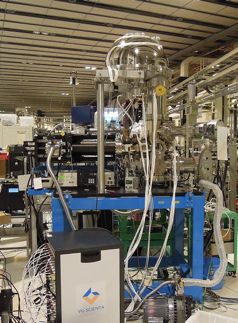
Fig. 1 Photo of the PES station.

Fig.2 [i] Optical microscope of Si (111) single crystal. By shaving the surface, the electronic state of each location can be analyzed by irradiating micro-focused soft X-rays on a clean surface (A), a shaved but rough surface (B), and an unshaved surface (C). [ii] Si 2p core-level spectra at each position. [iii] The energy constant surface mapping at position A.