Quasiparticle peak in angle-integrated PES spectrum of V2O3


Inquiry number
SOL-0000000959
Beamline
BL25SU (Soft X-ray Spectroscopy of Solid)
Scientific keywords
| A. Sample category | inorganic material |
|---|---|
| B. Sample category (detail) | metal, alloy, insulator, ceramics, solid-state crystal, crystal |
| C. Technique | photoemission, photoionization |
| D. Technique (detail) | photoelectron spectra |
| E. Particular condition | ultra-high vacuum, low-T (~ liquid N2) |
| F. Photon energy | soft X-ray |
| G. Target information | electronic state |
Industrial keywords
| level 1---Application area | Semiconductor |
|---|---|
| level 2---Target | silicon semiconductor, compound semiconductor |
| level 3---Target (detail) | |
| level 4---Obtainable information | electronic state |
| level 5---Technique | XPS |
Classification
M40.40 soft x-ray spectroscopy, M50.10 photoelectron spectroscopy
Body text
Angle-integrated photoemission spectroscopy is a powerful tool to investigate density of states of valence electronic states in solids. Photoemission spectra in the soft x-ray region are more bulk sensitive than those in the ultra violet region, because escape depths of photoelectrons become larger with increasing the excitation energy. The figure shows excitation energy dependence of valence photoemission spectra for V2O3. A quasiparticle peak is clearly observed by the soft x-ray photoemission spectroscopy.
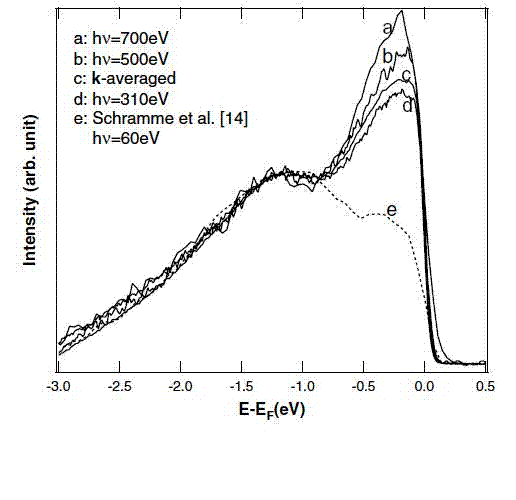
[ S.-K. Mo, J. D. Denlinger, H.-D. Kim, J.-H. Park, J. W. Allen, A. Sekiyama, A. Yamasaki, K. Kadono, S. Suga, Y. Saitoh, T. Muro, P. Metcalf, G. Keller, K. Held, V. Eyert, V. I. Anismov and D. Vollhardt, Physical Review Letters 90, 186403 (2003), Fig. 2,
©2003 American Physical Society ]
Source of the figure
Original paper/Journal article
Journal title
Phys. Rev. Lett.90, 186403 (2003)
Figure No.
2
Technique
Soft x-ray photoemission spectroscopy provides information of valence electronic states of solids. Photoelectrons emitted by illumination of soft x-rays are analyzed with a hemispherical electron analyzer (SES200). The excitation photon is tuned at an appropriate energy for the aim of investigation. Measurements are carried out in a UHV condition. Samples should have electric conductivity to avoid charging. Clean surfaces of the samples are obtained by cleaving or fracture in the UHV chamber.
Source of the figure
No figure
Required time for experimental setup
2 hour(s)
Instruments
| Instrument | Purpose | Performance |
|---|---|---|
| Photoemission Spectrometer (PES) | angle-integrated photoemission spectroscopy | high resolution |
References
| Document name |
|---|
| Phys. Rev. Lett. 90, 186403 (2003) |
Related experimental techniques
Questionnaire
The measurement was possible only in SPring-8. Impossible or very difficult in other facilities.
This solution is an application of a main instrument of the beamline.
Similar experiments account for more than 30% of the beamline's subject.
Ease of measurement
Easy
Ease of analysis
Middle
How many shifts were needed for taking whole data in the figure?
Four-nine shifts