共鳴光電子分光によるCe化合物のバルク電子状態の観測

Inquiry number
SOL-0000001500
Beamline
BL25SU (Soft X-ray Spectroscopy of Solid)
Scientific keywords
| A. Sample category | inorganic material |
|---|---|
| B. Sample category (detail) | metal, alloy, solid-state crystal, crystal |
| C. Technique | photoemission, photoionization |
| D. Technique (detail) | photoelectron spectra |
| E. Particular condition | ultra-high vacuum, low-T (~ liquid He) |
| F. Photon energy | soft X-ray |
| G. Target information | electronic state |
Industrial keywords
| level 1---Application area | industrial material |
|---|---|
| level 2---Target | |
| level 3---Target (detail) | |
| level 4---Obtainable information | electronic state |
| level 5---Technique | XPS |
Classification
M40.40 soft x-ray spectroscopy, M50.10 photoelectron spectroscopy
Body text
共鳴光電子分光は物質の電子状態を調べるための有効な手法です。いくつかの軌道成分からなる価電子帯の中から、特定の軌道成分の電子状態(部分状態密度)を選択的に観測することができます。軟X線を用いますので、真空紫外光のUPSに比べてバルク敏感です。さらに、分解能は100meV程度ですので、実験室系のXPSよりもフェルミ順位近傍の電子状態を詳細に観測できます。図に示すのは、Ce 4f共鳴光電子分光により、CeRu2Si2とCeRu2の3d-4f電子状態を比較した結果です(黒丸)。近藤温度の異なる物質では、フェルミ順位近傍の電子状態が全く異なることが明らかになりました。
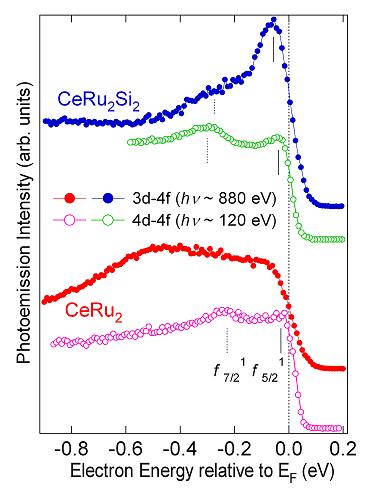
[ A. Sekiyama, T. Iwasaki, K. Matsuda, Y. Saitoh, Y. Oniki and S. Suga, Nature 403, 396-398 (2000), Fig. 3,
©2000 Nature Publishing Group ]
Source of the figure
Original paper/Journal article
Journal title
Nature vol.403 p396(2000)
Figure No.
Fig.3
Technique
共鳴光電子分光では、励起光のエネルギーを着目する元素の吸収端に合わせ、光電子スペクトルを測定します。例えば、CeRu2のCe 4f電子状態を観測したい場合、Ceの3d-4f吸収端(約880eV)に励起光をセットします。これにより、Ce 4f軌道の光電子放出強度が共鳴増大します。測定する試料には電気伝導性が必要です。絶縁体は光電子放出によって帯電するため、測定できません。試料は真空中での劈開や破断によって清浄表面を得ます。破断の難しい試料では真空中でのイオンボンバードやアニールによって清浄表面を得る必要があり、測定の難易度が上がります。
Source of the figure
No figure
Required time for experimental setup
2 hour(s)
Instruments
| Instrument | Purpose | Performance |
|---|---|---|
| 光電子分光装置 | 軟X線共鳴光電子分光 | 高エネルギー分解能 |
References
| Document name |
|---|
| Nature 403, 396 (2000) |
Related experimental techniques
Questionnaire
The measurement was possible only in SPring-8. Impossible or very difficult in other facilities.
This solution is an application of a main instrument of the beamline.
Similar experiments account for more than 30% of the beamline's subject.
Ease of measurement
Middle
Ease of analysis
Middle
How many shifts were needed for taking whole data in the figure?
Four-nine shifts