Mn 4p electronic states accompanied with magnetic phase transition in Mn3ZnC


Inquiry number
SOL-0000001030
Beamline
BL39XU (X-ray Absorption and Emission Spectroscopy)
Scientific keywords
| A. Sample category | inorganic material |
|---|---|
| B. Sample category (detail) | magnetic material |
| C. Technique | absorption and its secondary process |
| D. Technique (detail) | XANES, MCD, LD |
| E. Particular condition | polarization (circular), low-T (~ liquid N2), low-T (~ liquid He), magnetic field (< 2 T), magnetic field (> 2 T), room temperature |
| F. Photon energy | X-ray (4-40 keV) |
| G. Target information | electronic state, spin/magnetism, phase transition |
Industrial keywords
| level 1---Application area | storage device |
|---|---|
| level 2---Target | HD,MO |
| level 3---Target (detail) | magnetic layer |
| level 4---Obtainable information | local structure, electronic state, magnetic moment, magnetic anisotropy |
| level 5---Technique | XAFS, XMCD |
Classification
A80.14 magnetic materials, M40.30 XMCD
Body text
X-ray Magnetic Circular Dichroism (XMCD) is a unique technique to study electronic states for the specific element and its orbital. Using this technique, we can obtain information about the spin polarization of the unoccupied electronic states for the specific element in ferromagnetic materials. The electronic states of 3d transition elements (Cr-Cu), 4f rare-earth elements (La-Lu), and 5d transition elements (Hf-Pt, Au) in ferromagnetic materials can be investigated because circularly polarized X-rays in hard X-ray region (5-16 keV) are available at BL39XU of SPring-8.
The figure shows temperature dependence of XMCD spectra at the Mn K-edge (1s-4p)of Mn3ZnC. These data demonstrate the fact that Mn 4p electronic states change in response to the magnetic phase transition of Mn3ZnC and that the magnetic phase transition of Mn3ZnC is closely related with the variation of 4p orbital moment.

Fig. Temperature variation of Mn K-edge XMCD spectrum in Mn3ZnC.
[ H. Maruyama, N. Ishimatsu and N. Kawamura, Physica B 351, 328-332 (2004), Fig. 1,
©2004 Elsevier Science Publisher ]
Source of the figure
Original paper/Journal article
Journal title
H. Maruyama et al., Physica B 351, 328 (2004).
Figure No.
Fig. 1
Technique
XMCD spectrum is measured by monitoring the difference in X-ray absorption of the sample between for right- and left-circularly polarized X-rays, as a function of the X-ray energy. In this solution, the information about the spin polarization of Mn 4p unoccupied electronic states can be mainly obtained by measuring XMCD spectra at the Mn K-edge because of the electronic excitation from 1sto4p states.
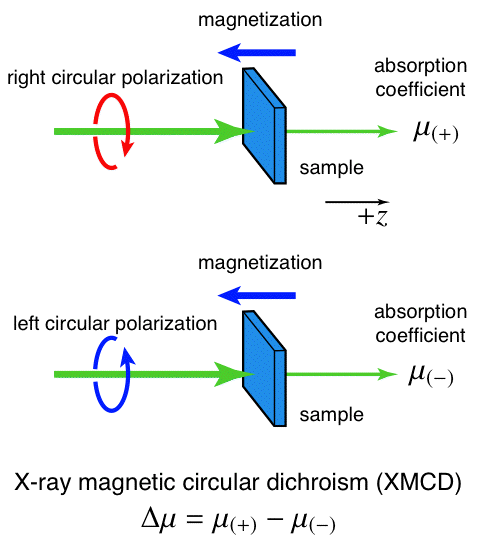
Fig. Principle of X-ray magnetic circular dichroism (XMCD) measurement.
Source of the figure
Private communication/others
Description
鈴木基寛氏による作成
Required time for experimental setup
5 hour(s)
Instruments
| Instrument | Purpose | Performance |
|---|---|---|
| Electromagnet and closed-cycle helium refrigerator | measurement of XMCD spectrum at low temperature | maximum applied magnetic field of 2 T, temperature range of 20-300 K at sample position |
| 10 T superconducting magnet | measurement of XMCD spectrum under high magnetic field at extreme low | maximum applied magnetic field of 10 T, temperature range of 2-300 K at sample position |
| Helicity-modulation XMCD | detection of high accuracy and high sensitivity XMCD signal | dichroic signal less than 0.1% is detectable |
References
| Document name |
|---|
| H. Maruyama, N. Ishimatsu, and N. Kawamura, Physica B 351, 328 (2004). |
| S. Uemoto, H. Maruyama, N. Kawamura, S. Uemura, N. Kitamoto, H. Nakao, S. Hara, M. Suzuki, D. Fruchart, and H. Yamazaki, J. Synchrotron Rad. 8, 449 (2001). |
Related experimental techniques
Magnetization measurement, X-ray magnetic circular dichroism in soft X-ray resion, X-ray magnetic scattering
Questionnaire
The measurement was possible only in SPring-8. Impossible or very difficult in other facilities.
This solution is an application of a main instrument of the beamline.
Similar experiments account for more than 30% of the beamline's subject.
Ease of measurement
Easy
Ease of analysis
Middle
How many shifts were needed for taking whole data in the figure?
Two-three shifts