X-ray magnetic circular dichroism under extreme condition by using superconducting magnet

Inquiry number
SOL-0000001032
Beamline
BL39XU (X-ray Absorption and Emission Spectroscopy)
Scientific keywords
| A. Sample category | research on method, instrumentation |
|---|---|
| B. Sample category (detail) | metal, alloy, semiconductor, superconductor, magnetic material, insulator, ceramics, solid-state crystal, amorphous, glass, membrane |
| C. Technique | absorption and its secondary process |
| D. Technique (detail) | XAFS, EXAFS, XANES, MCD, LD |
| E. Particular condition | polarization (circular), high pressure (DAC), extreme low-T (< 4 K), magnetic field (> 2 T) |
| F. Photon energy | X-ray (4-40 keV) |
| G. Target information | chemical state, local structure, electronic state, spin/magnetism, phase transition |
Industrial keywords
| level 1---Application area | Semiconductor, storage device |
|---|---|
| level 2---Target | HD,MO |
| level 3---Target (detail) | magnetic layer, magnetic head, spin valve |
| level 4---Obtainable information | local structure, electronic state, magnetic moment, magnetic anisotropy, interface magnetic structure, valence, chemical state |
| level 5---Technique | XAFS, XMCD |
Classification
A80.12 semiconductor, A80.14 magnetic materials, A80.20 metal ・material, M40.10 XAFS, M40.30 XMCD
Body text
X-ray Magnetic Circular Dichroism (XMCD) is a unique technique to study electronic states for the specific element and its orbital.XMCD measurement under high magnetic field can be performed by using superconducting magnet (SCM) at BL39XU of SPring-8 because a diamond X-ray phase retarder enables to generate left and right circularly polarized X-rays.
Maximum magnetic field of 10 T can be applied by using this SCM, and sample temperature can be controlled in the range of 2-300 K. Studies on metamagnetism transition in which ferromagnetic state is induced by applying high magnetic field or on ferromagnetic states in the extreme low temperature region are actively performed by installing the SCM. In particular, sample environment under high magnetic field at extreme low temperature is effective to study ferromagnetic compounds including lanthanoid or actinoid elements. Recently, a diamond-anvil-cell (DAC) for generating high pressure is mounted in the SCM (see in Fig. 1) so that the XMCD measurement is performed under extreme conditions of high pressure,high magnetic field, and extreme low temperature.
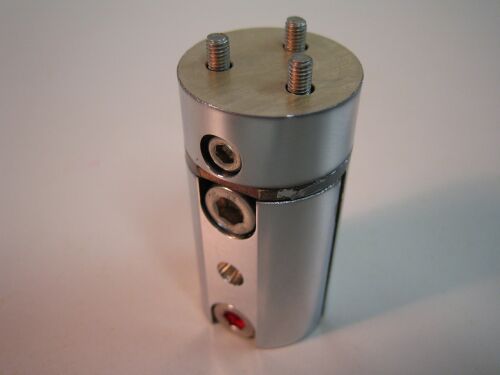
Fig. 1 Diamond-anvil-cell (DAC) which enables to be mounted in the superconducting magnet
(designed by Dr. Ishimatsu of Hiroshima University).
Fig. 2 shows the XMCD spectrum under high pressure at Pt L3-edge in ordered-FePt alloy. This is the result under the field of H = 10 T at the pressure of P = 20 GPa at room temperature. Fig. 3 shows pressure dependent of the ratio Lz/Sz of Pt 5d electrons according to magneto-optical sum rules, where Lz and Sz represent the expectation of orbital and spin magnetic moments, respectively. Thus, XMCD spectrum enables to measure under extreme conditions of high magnetic field,high pressure, and extreme low temperature.
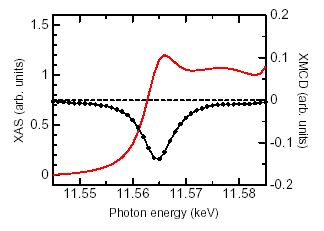
Fig.2 Pt L3-edge XMCD spectrum of ordered-FePt alloy under the field of H = 10 T,
the pressure of P = 20 GPa at room temperature.
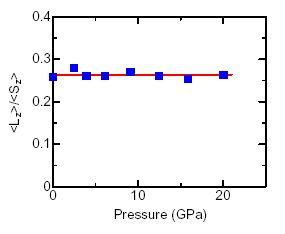
Fig. 3 Pressure dependence of Lz/Sz of Pt 5d electrons in ordered-FePt alloy (H = 10 T).
Source of the figure
Private communication/others
Description
広島大学 石松氏から提供
Technique
An X-ray magnetic circular dichroism (XMCD) spectrum is measured by monitoring a small difference in X-ray absorption spectra between for right- and left-circular polarizations. In this solution, X-ray energy was tuned to the characteristic absorption edges of Pt to observe magnetism of the Pt 5d electrons.
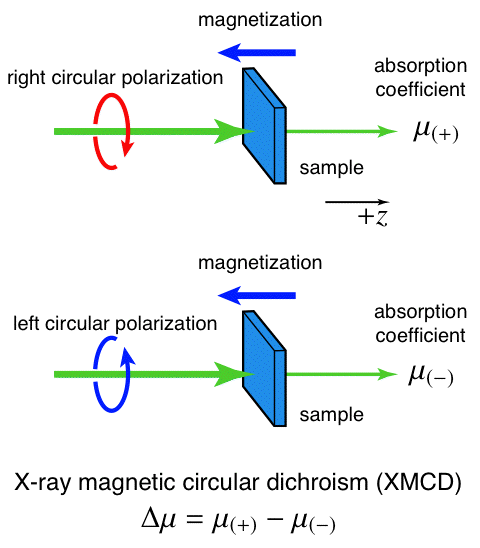
Fig. Principle of X-ray magnetic circular dichroism (XMCD) measurement.
Source of the figure
Private communication/others
Description
鈴木基寛氏により作成
Required time for experimental setup
6 hour(s)
Instruments
| Instrument | Purpose | Performance |
|---|---|---|
| 10 T superconducting magnet | measuremento of X-ray magnetic circular dichroism spectrum and element specified magnetization process under extreme condition | maximum applied magnetic field of 10 T, temperature range of 2-300 K at sample position |
References
| Document name |
|---|
| 石松直樹、山田真裕、圓山裕、河村直己、第46回 高圧討論会、室蘭工業大学、2P24、2005年10月. |
| S. Uemoto, H. Maruyama, N. Kawamura, S. Uemura, N. Kitamoto, H. Nakao, S. Hara, M. Suzuki, D. Fruchart, and H. Yamazaki, J. Synchrotron Rad. 8, 449 (2001). |
| J. Chaboy, C. Piquer, N. Plugaru, M. Artigas, H. Maruyama, N. Kawamura, and M. Suzuki, J. Appl. Phys. 93, 475 (2003). |
| J. Chaboy, H. Maruyama, N. Kawamura, and M. Suzuki, Phys. Rev. B 69, 014427 (2004). |
| T. Honma, N. Kawamura, M. Suzuki, M. Mizumaki, H. Maruyama, N. Ishimatsu, Y. Inada, and Y. Onuki, J. Physics: Condensed Matter 15, S2171 (2003). |
| J. Chaboy, M. A. Laguna-Marco, M. C. Sanchez, H. Maruyama, N. Kawamura, and M. Suzuki, Phys. Rev. B 69, 134421 (2004). |
| H. Maruyama, N. Ishimatsu, and N. Kawamura, Physica B 351, 328 (2004). |
| Y. Yamamoto, T. Miura, M. Suzuki, N. Kawamura, H. Miyagawa, T. Nakamura, K. Kobayashi, T. Teranishi, and H. Hori, Phys. Rev. Lett. 93, 116801 (2004). |
Related experimental techniques
Questionnaire
The measurement was possible only in SPring-8. Impossible or very difficult in other facilities.
This solution is an application of a main instrument of the beamline.
With user's own instruments.
Ease of measurement
Middle
Ease of analysis
Middle
How many shifts were needed for taking whole data in the figure?
Two-three shifts