Microsecond time-resolved X-ray diffraction study of purple membrane

Inquiry number
SOL-0000004530
Beamline
BL40XU (SAXS ID)
Scientific keywords
| A. Sample category | biology, medicine |
|---|---|
| B. Sample category (detail) | membrane, biology (in vitro), protein |
| C. Technique | X-ray diffraction |
| D. Technique (detail) | small angle scattering, wide angle scattering |
| E. Particular condition | 2D imaging, time-resolved (µs), pump probe |
| F. Photon energy | X-ray (4-40 keV) |
| G. Target information | molecular structure, local structure, structure analysis, structural change, function and structure, function |
Industrial keywords
| level 1---Application area | Pharmaceuticals |
|---|---|
| level 2---Target | process analytical technology (PAT) |
| level 3---Target (detail) | protein, organism |
| level 4---Obtainable information | supra-molecular assemblies |
| level 5---Technique | diffraction, SAX, SAXS |
Classification
M20.10 SAX
Body text
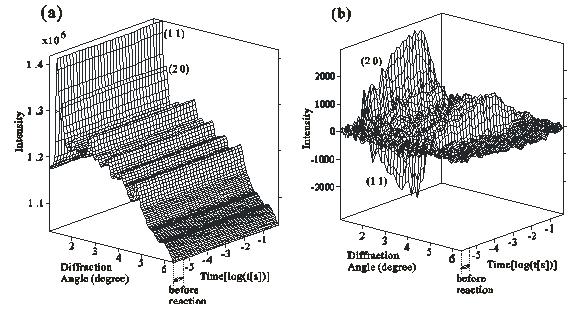
The structural changes in the photoreaction cycle of BR was investigated at a resolution of 7 by time-resolved X-ray diffraction experiment utilizing synchrotron X-rays from an undulator of SPring-8. The X-ray diffraction measurement system, used in coupling with a pulsed YAG laser, enabled to record diffraction pattern from purple membrane film at a time-resolution of 6 msec over the time domain of 5 orders. The population of the reaction intermediate was prominent observed at around 5 msec after a photo-stimulus sec to 500 msec. In the time domain, the functionally most important M-intermediate appears.The population of the reaction intermediate was prominent observed at around 5 msec after a photo-stimulus.
Source of the figure
Beamline Report
Page
17
Technique
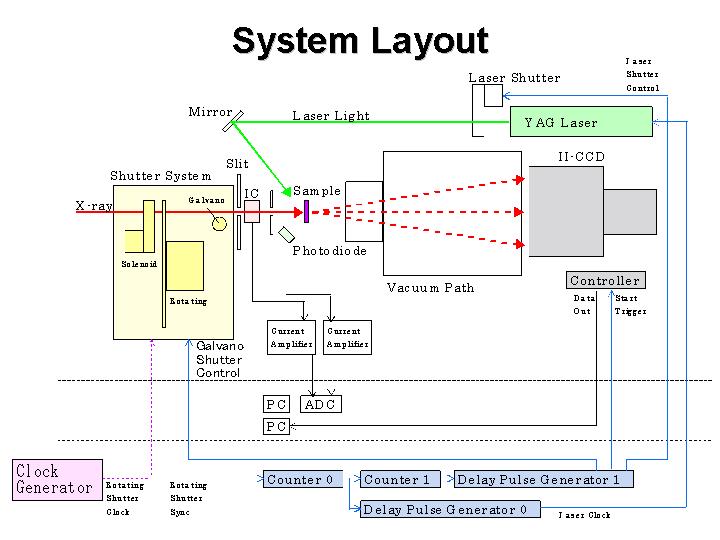
A microsecond time-resolved diffraction and scattering measurements system using semi-monochromatic X-ray pulses from SPring-8 BL40XU was constructed to measure a transient state of a sample. The X-ray pulse width of the system is 6 μs at the present state. This system is focused on small-angle diffraction or scattering experiments, although minor changes of the system enable time-resolved Laue diffraction measurements as well. Measurement sequence using X-ray pulses is as follows; a sample reaction is started (by exposing laser light etc.), and then, after a delay, a pulsed X-ray is exposed on the sample to measure diffraction or scattering from a transient state (the so-called pump-and-probe method). In many cases, it is needed to change the delay time, or sample conditions to obtain an entire set of sequence data, and to repeat the same procedure to improve data quality. An X-ray pulse is produced by a rotating disk shutter and an open-close shutter. Sigma Koki (Japan) made all shutters specially for BL40XU. Rotating type shutters have also been used in time-resolved Laue experiments to extract single bunch white X-ray pulses. There are two rotating shutters, one of which rotates fast, and the other slowly. Continuous X-ray is changed into sequential X-ray pulses by passing through the slit of a rotating shutter. A rotating disk shutter has a circular disk that has two sets of small, medium, and large slits centrosymmetrically on its disk to create X-ray pulses of different time widths. The clock of the fast rotating shutter is selectable from internal and external. Using an external clock, rotating speed of the fast rotating shutter is tunable from 270 to 100 Hz. Time width of X-ray pulse is from 5.3 to 120 μs theoretically. Time interval of each 5.3 μs X-ray pulse is 1.84ms. X-ray pulse width of the slow rotating disk shutter, whose frequency is changeable from 56.7 to 16.7 Hz, is from 136 μs to 10 ms. An open-close shutter is made from an actuator of a galvanometer scanner. A piece of tantalum plate (height 3 mm, width 4.5 mm, thickness 0.5 mm) is attached to a swing axis of the galvanometer head to stop or pass X-rays. It takes 0.3 ms to move from an open position to a close position, or oppositely. The open-close shutter alone can make an about 2 ms or wider X-ray pulse. Combination of the two shutters passes only one X-ray pulse. The experimental set up is conceptually shown in a following figure.
Source of the figure
Presentation material for Beamline Report
Required time for experimental setup
12 hour(s)
Instruments
| Instrument | Purpose | Performance |
|---|---|---|
| x-ray shutter sstem | generate pulsed x-ray | shortest pulse width : 6 micro sec |
| SAXS optics | measurement | spatial resolution : 2000 Å to a few Å |
References
| Document name |
|---|
| Biophysical Journal, 88 , 436 –442, (2005) |
Related experimental techniques
Questionnaire
The measurement was possible only in SPring-8. Impossible or very difficult in other facilities.
This solution is an application of a main instrument of the beamline.
Ease of measurement
With a great skill
Ease of analysis
With a great skill
How many shifts were needed for taking whole data in the figure?
More than ten shifts