高分解能X線CTによる金属材料の結晶粒界3D可視化

Inquiry number
SOL-0000001698
Beamline
BL47XU (Micro-CT)
Scientific keywords
| A. Sample category | inorganic material |
|---|---|
| B. Sample category (detail) | metal, alloy |
| C. Technique | absorption and its secondary process |
| D. Technique (detail) | |
| E. Particular condition | 3D imaging (cf. CT), room temperature |
| F. Photon energy | X-ray (4-40 keV) |
| G. Target information | local structure, dislocation, strain, structural change, morphology |
Industrial keywords
| level 1---Application area | mechanics |
|---|---|
| level 2---Target | |
| level 3---Target (detail) | |
| level 4---Obtainable information | surface,interface, local structure, crack, crevice |
| level 5---Technique | imaging |
Classification
A80.20 metal ・material, M60.20 X-ray CT
Body text
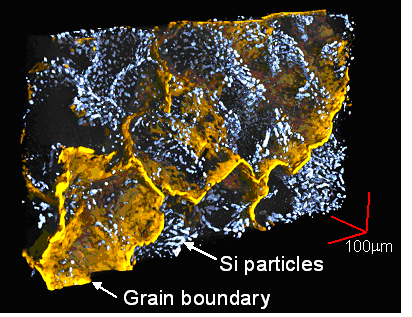
液体金属ドーピング法を用いたX線CTは,液体金属を粒界に含浸して可視化する手法です。ナノメーターオーダーと現在の最高分解能の放射光CTよりさらに3桁も小さなナノ構造である結晶粒界を、材料内部で3-D観察することができます。図に示したのは,AC4CHアルミニウム鋳造合金における共晶組織部のSi粒子と結晶粒界の構造です。結晶粒界のマクロ構造は低融点金属のGaで粒界を装飾することによって可視化されました。粒界は一部では共晶部に沿って,また一部では共晶部を分けるように複雑に湾曲して存在していることが分かります。
Source of the figure
Original paper/Journal article
Journal title
K. H. Khor, H. Toda, et, Journal of Physics: Condensed Matter, 16 (2004), S3511-S3515
Figure No.
Technique
Source of the figure
No figure
Required time for experimental setup
1 shift(s)
Instruments
| Instrument | Purpose | Performance |
|---|---|---|
| X線CT装置 | 物体の内部構造を測定する | 空間分解能で約1ミクロン程度 |
References
| Document name |
|---|
| K. H. Khor, H. Toda, et, Journal of Physics: Condensed Matter, 16 (2004), S3511-S3515 |
| 小林正和,戸田裕之,他:軽金属学会第108回春期大会講演概要(2005),p.215-216. |
| T. Ohgaki, H. Toda, et al. Mater Sci Engng, (2005), in press. |
| M. Kobayashi, H. Toda, Scripta Mater., to be submitted. |
Related experimental techniques
Questionnaire
The measurement was possible only in SPring-8. Impossible or very difficult in other facilities.
This solution is an application of a main instrument of the beamline.
Ease of measurement
Middle
Ease of analysis
Middle
How many shifts were needed for taking whole data in the figure?
Two-three shifts