Materials Structure Science
Extracting Functions from the Arrangement of Atoms and Molecules

Fundamental Understanding of the Functional Properties of Materials due to Precise Structural Analyses
Modern society is prosperous due to the support of various materials and basic substances with diverse functions. However, society is currently facing serious energy and environmental issues. In order to continue sustainable development, it is imperative that society creates innovative materials and utilizes their functions more effectively. To meet these demands, materials structure science strives to understand the structures and functions as well as design innovative materials. Materials structure science research conducted at SPring-8 employs the most precise and powerful technologies currently available. SPring-8 is one of three operational third-generation large synchrotron facilities in the world, and continues to be a leader in international materials structure science research by expanding the research frontier and further advancing technologies for materials science.
SPring-8 Has Opened the Door to Precise Structural Analyses
Diverse devices and instruments are constructed and protected by mechanically strong and chemically stable materials. Moreover, in today's information society, metals and semiconductors with superior electron transport properties are indispensable for electronic components in devices and instruments, and materials with high chemical activities such as catalysts are necessary to address energy and environmental issues. Regardless of the organic or inorganic composition, all materials are composed of elements found in the periodic table. Thus, in principle, the physical properties of all materials can be revealed by identifying the species and arrangements of the constituent elements. Research that investigates the relationship between structure and the physical properties of materials is called “materials structure science research”, which is a major academic field to promote materials design with advanced functions.
Materials structure science research has been advancing rapidly since the discovery of diffraction phenomena of X-rays and electron beams, and is now indispensable in understanding the physical properties of materials and designing functional materials. However, in cases where the physical properties are controlled by structural changes on scales smaller than the precision of techniques currently available, materials structure science research must be based on empirical factors and information obtained from other measurement techniques. In other words, much of the history of materials structure science research involves improving the precision of structural analysis. In the beginning, materials structure science research contributed significantly to a few research fields such as research on ferroelectrics in which dielectric polarization is induced by relatively large position displacements of atoms on the 0.01 nm scale (nm = 10-9 m). However, because modern cutting-edge experiments require extremely precise measurements, techniques developed in the early era of materials structure science research are fast becoming obsolete. On the other hand, SPring-8 can contribute to modern materials structure science research.
Synchrotron radiation at SPring-8 has superior properties, including high brilliance, low emittance (small beam size, low dispersion, high directionality), and a wide range of available energies (wavelengths). Precise experiments using such superior synchrotron radiation have made it possible to obtain sufficiently strong signals (information) even from minuscule sample amounts, and have yielded highly accurate diffraction images. Two examples to demonstrate the capabilities of synchrotron radiation at SPring-8 are the research projects involving BaTiO3 and Fe(phen)2 (NCS)2 . BaTiO3 is a ferroelectric material, and diffraction images were measured on a ~100 nm sample, which has 1/1,000,000,000 of the volume of samples commonly used in conventional experiments (~100 μm (μm = 10-6 m)). Additionally, the anisotropy of Fe-N binding in a spin crossover complex, Fe (phen)2 (NCS)2, was determined with a precision less than 0.001 nm, and revealed the diversity of electron spin states induced by photoirradiation.
Advances in high-precision structural analysis are not limited to reduced sample size or improved precision. Because diffraction data is best suited to determine the position of atoms, conventional analyses are limited to examining periodic atomic arrangements. However, the high precision diffraction data obtained from new analysis techniques can visualize the spatial distributions of electrons in atoms as well as provide information about the electronic properties, which determine the chemical bonds between atoms and the electric conductivity of materials. Moreover, the spatial distribution density gradient of electrons enables the spatial distributions of electric fields (distributions of electric physical quantities) to be visualized. For example, the spatial distributions of electric fields of nanoporous materials, which exhibit molecular storage and transport functionalities, as well as those of PbTiO3, which is a potential next generation piezoelectric material, have been visualized (Fig. 2). At SPring-8, materials structure science research has reached the point where the mutual relationship between structures and material properties can be directly investigated.
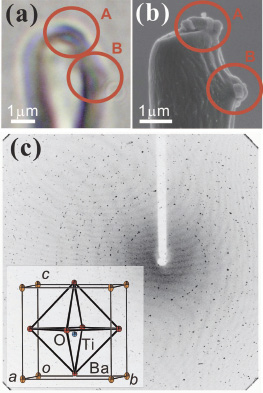
Images of nanocrystal particles (A, B) attached on a glass rod: (a) optical image and (b) scanning electron microscope image. (c) Measured diffraction image and structure model reconstructed from the analysis results. (Reprinted with the permission from Yasuda, Murayama, Fukuyama, Kim, Kimura, Toriumi, Tanaka, Moritomo, Kuroiwa, Kato, Tanaka and Takata (2009), J. Synchrotron Rad. Vol. 16. pp.352-357.)
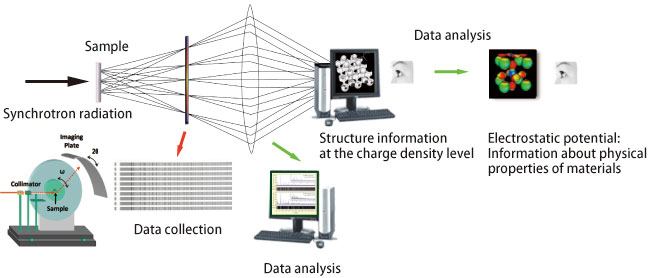
Fig. 2. Analysis sequence of precision X-ray diffraction experiments on the electron density distribution and electrostatic potential mapping
Conducting Materials Structure Science Research at SPring-8
Given the fact that even resource-rich countries like the United States have fully supported materials research by constructing a third-generation synchrotron radiation facility, for Japan, a resource-less country, to thrive in the international community, the highly effective utilization of natural resources and the development of man-made resources are fundamentally important. To sustain an information society, it is especially urgent to develop substances and hardware essential for high-speed operations of electronic devices as well as to elucidate the reaction processes of catalytic reactions and chemical reactions.
Besides conducing conventional static science research under normal conditions, the dynamic structures of materials and their electron states under special environments such as high temperature, high pressures, and strong magnetic fields must be elucidated to fully understand and utilize the advanced functions of materials. By taking advantage of the superiority of synchrotron radiation sources at SPring-8, researchers can study material structures under locally reproduced extreme environmental conditions. SPring-8 has already contributed to the elucidation of the dynamic changes in material structures through its stable pulse performance of synchrotron radiation and control technologies. For example, the high-speed time resolved analysis techniques available at SPring-8 have helped reveal the dynamic changes that occur during the writing process, which is on a 0.3-μs time scale, of a high-speed high-density readable/writable DVD. Additionally, SPring-8 is the only facility that can conduct diffraction experiments under conditions exceeding 350 GPa (GPa = 109 Pa = ~10,000 atm) and 5,000 K, which encompass all environmental conditions found inside the Earth (Fig. 3). These unique experimental environments will not only aid in understanding the Earth's interior, but will also assist in the discovery of new material phases and the development of innovative functional materials.
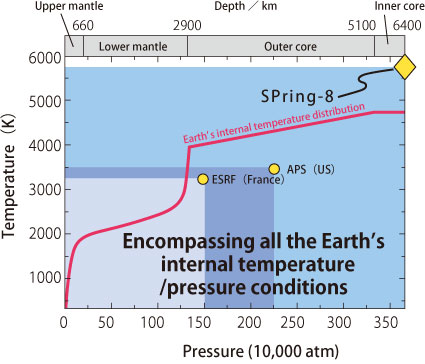
For the first time, an extremely high pressure/temperature environment (364 GPa (GPa = 109 Pa = ~10,000 atm), 5,500 K) equivalent to the center of the Earth has been reproduced in a laboratory. All the Earth's internal temperature/pressure conditions can now be reproduced at SPring-8.