Undercooled liquids

Inquiry number
SOL-0000001139
Beamline
BL04B2 (High Energy X-ray Diffraction)
Scientific keywords
| A. Sample category | inorganic material |
|---|---|
| B. Sample category (detail) | liquid, melt |
| C. Technique | X-ray diffraction |
| D. Technique (detail) | wide angle scattering |
| E. Particular condition | high-T (> 500 C) |
| F. Photon energy | X-ray (> 40 keV) |
| G. Target information | structure analysis |
Industrial keywords
| level 1---Application area | mechanics, industrial material, others |
|---|---|
| level 2---Target | Steel |
| level 3---Target (detail) | |
| level 4---Obtainable information | structure of non-crystalline material |
| level 5---Technique | diffraction |
Classification
M20.20 middle angle scattering
Body text
High-energy x-ray diffraction is a powerful technique to study the structure of leviated liquids. Using this technique, one can obtain interatomic correlations of disordered structure in liquids. The high-flux high-energy x-rays allow us to measure reliable diffraction pattern of small size of leviated liquids.
Figure 1 (a) shows a conical nozzle leivation equipment integrated with the two-axis diffractometer for disordered materials in BL04B2 beamline. The leviated specimen is shown in Fig. 1(b).
Figure 2 shows structure factor of Zr70Cu30 liquid obtained at 1453 K. As can be seen from Fig. 1(b), we have succeeded in obtaining the high-quality data of levitated liquid. A combination of the use of high-energy x-rays and a conical nozzle leviation will allow us to study the structure of deeply undercooled liquids.
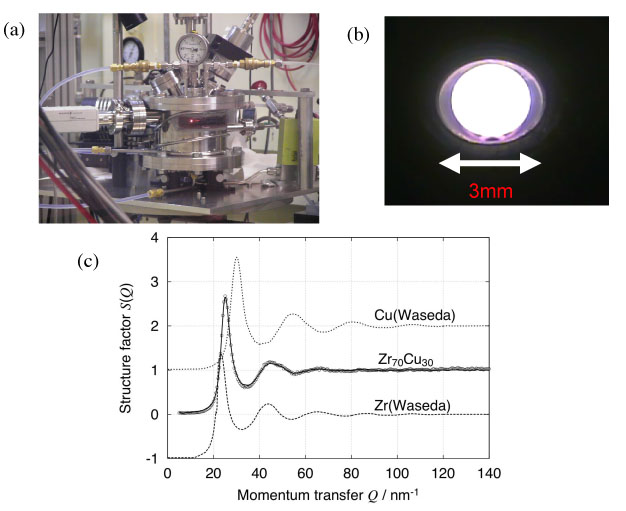
Fig. 1 Photograph of a conical nozzle leviation equipment (a) and a levitated specimen (Zr70Cu30, 1453 K) (b), and the structure factor S(Q).
[ S. Nakano, S. Yamaura, A. Kitano, M. Sato, N. Umesaki, S. Uchinashi, H. Kimura and A. Inoue, Materials Transactions 46, 379-381 (2005), Fig. 3,
©2005 The Japan Institute of Metals ]
Source of the figure
Original paper/Journal article
Journal title
Mater. Trans. 46 (2005)
Figure No.
3
Technique
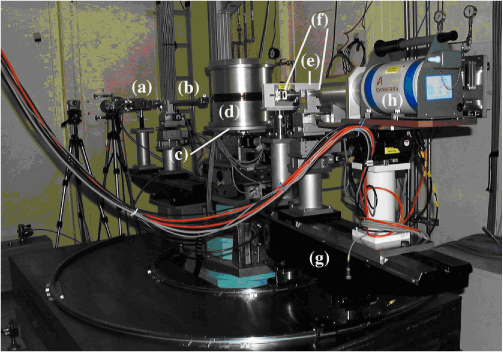
High-energy x-ray diffraction is a powerful tool to study the structure of disordered materials. The analysis of the diffraction pattern makes it possible to derive inter-atomic distance, coordination number and so on. One of the advantage of the diffraction in comparison with EXAFS is that intermediate-range order, which can be analyzed by computer simulation based on diffraction data. A combination of high-energy x-ray diffraction, neutron diffraction, and computer simulation is an essential tool to study the structure of disordered materials.
[ S. Kohara, Y. Ohishi, M. Takata, Y. Yoneda and K. Suzuya, Journal of the Crystallographic Society of Japan 47, 123-129 (2005), Fig. 1,
©2005 The Crystallographic Society of Japan ]
Source of the figure
Original paper/Journal article
Journal title
日本結晶学会誌,47,123-129(2005)
Figure No.
Required time for experimental setup
24 hour(s)
Instruments
| Instrument | Purpose | Performance |
|---|---|---|
| Two-axis diffractometer | to get diffraction pattern | 113.4 keV |
References
| Document name |
|---|
| X線構造解析—原子の配列を決める 材料学シリーズ 早稲田 嘉夫, 松原 英一郎 |
Related experimental techniques
Questionnaire
The measurement was possible only in SPring-8. Impossible or very difficult in other facilities.
This solution is an application of a main instrument of the beamline.
This solution is application of a new instrument installed in the past two years.
With user's own instruments.
Ease of measurement
With a great skill
Ease of analysis
Middle
How many shifts were needed for taking whole data in the figure?
Two-three shifts