Energy and time analysis of internal conversion electrons from 57Fe

Inquiry number
SOL-0000001197
Beamline
BL09XU (HAXPES I)
Scientific keywords
| A. Sample category | inorganic material, research on method, instrumentation |
|---|---|
| B. Sample category (detail) | metal, alloy, magnetic material |
| C. Technique | nuclear excitation, Mössbauer effect |
| D. Technique (detail) | nuclear excitation processes |
| E. Particular condition | time-resolved (ns), room temperature |
| F. Photon energy | X-ray (4-40 keV) |
| G. Target information | phonon |
Industrial keywords
| level 1---Application area | storage device |
|---|---|
| level 2---Target | HD,MO |
| level 3---Target (detail) | magnetic layer |
| level 4---Obtainable information | surface,interface, magnetic moment |
| level 5---Technique | scattering |
Classification
A30.20 surface・interface, A80.14 magnetic materials
Body text
In this solution, energy distribution and time spectra of internal from 57Fe were measured. The emission signal of conversion electrons excited with incident X-ray photons was discriminated by electron energy analysis and intense prompt noise was excluded in the signal processing. The analyzer was a planar electrostatic quadrupole type which realized the energy resolution of 4% corresponding to the escape depth of 20 nm. These data suggest the possibility of depth sensitive nuclear inelastic scattering by electron detection.
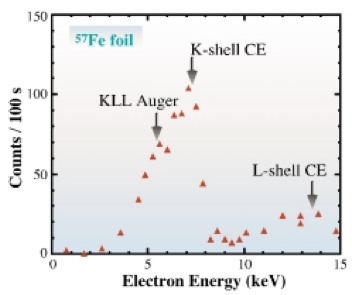
Fig. Energy distribution of electron emission from 57Fe foil within a time-interval
between 10 and 190 ns after incidence of primary photons.
Source of the figure
Bulletin from SPring-8
Bulletin title
Reaearch Frontiers 1997/1998
Page
26
Technique
Source of the figure
No figure
Required time for experimental setup
hour(s)
Instruments
References
Related experimental techniques
Questionnaire
The measurement was possible only in SPring-8. Impossible or very difficult in other facilities.
Ease of measurement
With a great skill
Ease of analysis
Middle
How many shifts were needed for taking whole data in the figure?
Two-three shifts