Fe4Nの圧力誘起磁気相転移の観測

Inquiry number
SOL-0000001607
Beamline
BL39XU (X-ray Absorption and Emission Spectroscopy)
Scientific keywords
| A. Sample category | inorganic material |
|---|---|
| B. Sample category (detail) | magnetic material |
| C. Technique | absorption and its secondary process |
| D. Technique (detail) | XANES, MCD, LD |
| E. Particular condition | polarization (circular), high pressure (DAC), magnetic field (< 2 T), room temperature |
| F. Photon energy | X-ray (4-40 keV) |
| G. Target information | electronic state, spin/magnetism, phase transition |
Industrial keywords
| level 1---Application area | storage device |
|---|---|
| level 2---Target | HD,MO |
| level 3---Target (detail) | magnetic layer |
| level 4---Obtainable information | local structure, electronic state, magnetic moment, magnetic anisotropy |
| level 5---Technique | XAFS, XMCD |
Classification
A80.14 magnetic materials, M40.30 XMCD
Body text
X線磁気円二色性(XMCD)は元素別にしかも電子軌道を選別してその電子状態を調べることのできるユニークな手法です。また、XMCD強度は試料の磁化の大きさに比例します。したがってこの手法を用いることで、注目している磁性原子の磁気モーメントの相対的な大きさを温度や磁場、圧力のような外場の関数として得ることができます。SPring-8 BL39XU では、硬X線領域(5-16 keV)の円偏光X線を利用できるため、強磁性物質中に含まれるCr~Cuのような3d遷移金属、La~Luのような4f希土類元素、Hf~Pt, Auのような5d遷移金属について調べることができます。
図に示すのは、Fe4Nについて測定したFe K-吸収端(1s4p)でのXMCD強度の圧力変化です。この結果から、Fe原子が面心立方格子を形成して強磁性が比較的安定だと考えられていたFe4Nにおいても、24 GPa以上加圧することによってFeが磁気モーメントを失うことがわかりました。また、圧力履歴が存在しないことから、この圧力誘起相転移が二次相転移であることがわかりました。
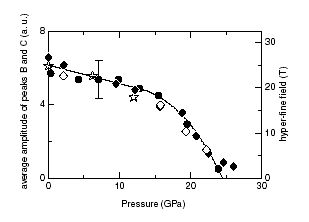
図.Fe4NにおけるFe K-吸収端でのXMCD強度の圧力依存性。
[ N. Ishimatsu, H. Maruyama, N. Kawamura, M. Suzuki, Y. Ohishi, M. Ito, S. Nasu, T. Kawakami and Osamu, Journal of the Physical Society of Japan 72, 2372-2376 (2003), Fig. 2,
©2003 日本物理学会 ]
Source of the figure
Original paper/Journal article
Journal title
N. Ishimatsu et al., J. Phys. Soc. Jpn. 72, 2372 (2003).
Figure No.
Fig. 2
Technique
XMCDスペクトルは、右回りと左回り円偏光X線の吸収量の差をエネルギーの関数として測定することによって得られます。また、XMCD強度は試料の磁化に比例するため、その性質を利用することによって、化合物中に含まれる複数種の磁性原子に対して元素別にその磁化の相対的な大きさを知ることができます。この例では、Fe K-吸収端でXMCD強度の圧力変化を測定することによって、Fe4N中のFeの磁気モーメントの圧力変化に関する情報が得られます。
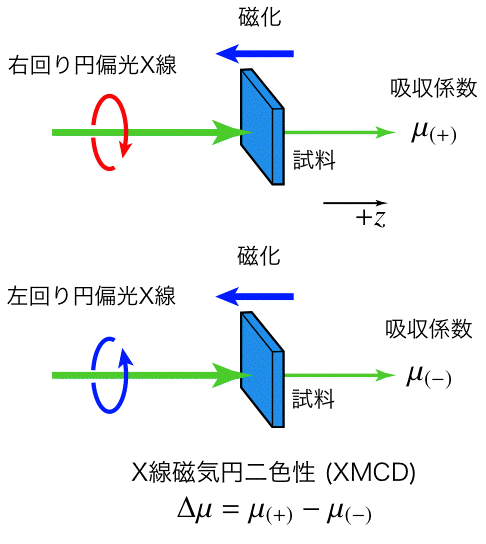
図.X線磁気円二色性(XMCD)測定の原理。
Source of the figure
Private communication/others
Description
鈴木基寛氏による作成
Required time for experimental setup
5 hour(s)
Instruments
| Instrument | Purpose | Performance |
|---|---|---|
| XMCD測定用電磁石およびクライオスタット | 室温から低温にかけてX線磁気円二色性スペクトルを測定 | 最大印加磁場 2 T、試料温度 20-300 K |
References
| Document name |
|---|
| N. Ishimatsu, Y. Ohishi, M. Suzuki, N. Kawamura, M. Ito, H. Maruyama, S. Nasu, T. Kawakami, and O. Shimomura, Nucl. Instrum. Methods Phys. Res. A 467-468, 1061 (2001). |
| N. Ishimatsu, H. Maruyama, N. Kawamura, M. Suzuki, Y. Ohishi, M. Ito, S. Nasu, T. Kawakami, and O. Shimomura, J. Phys. Soc. Jpn. 72, 2372 (2003). |
Related experimental techniques
磁化測定、X線磁気散乱、メスバウアー分光
Questionnaire
The measurement was possible only in SPring-8. Impossible or very difficult in other facilities.
This solution is an application of a main instrument of the beamline.
With user's own instruments.
Ease of measurement
Middle
Ease of analysis
Middle
How many shifts were needed for taking whole data in the figure?
More than ten shifts